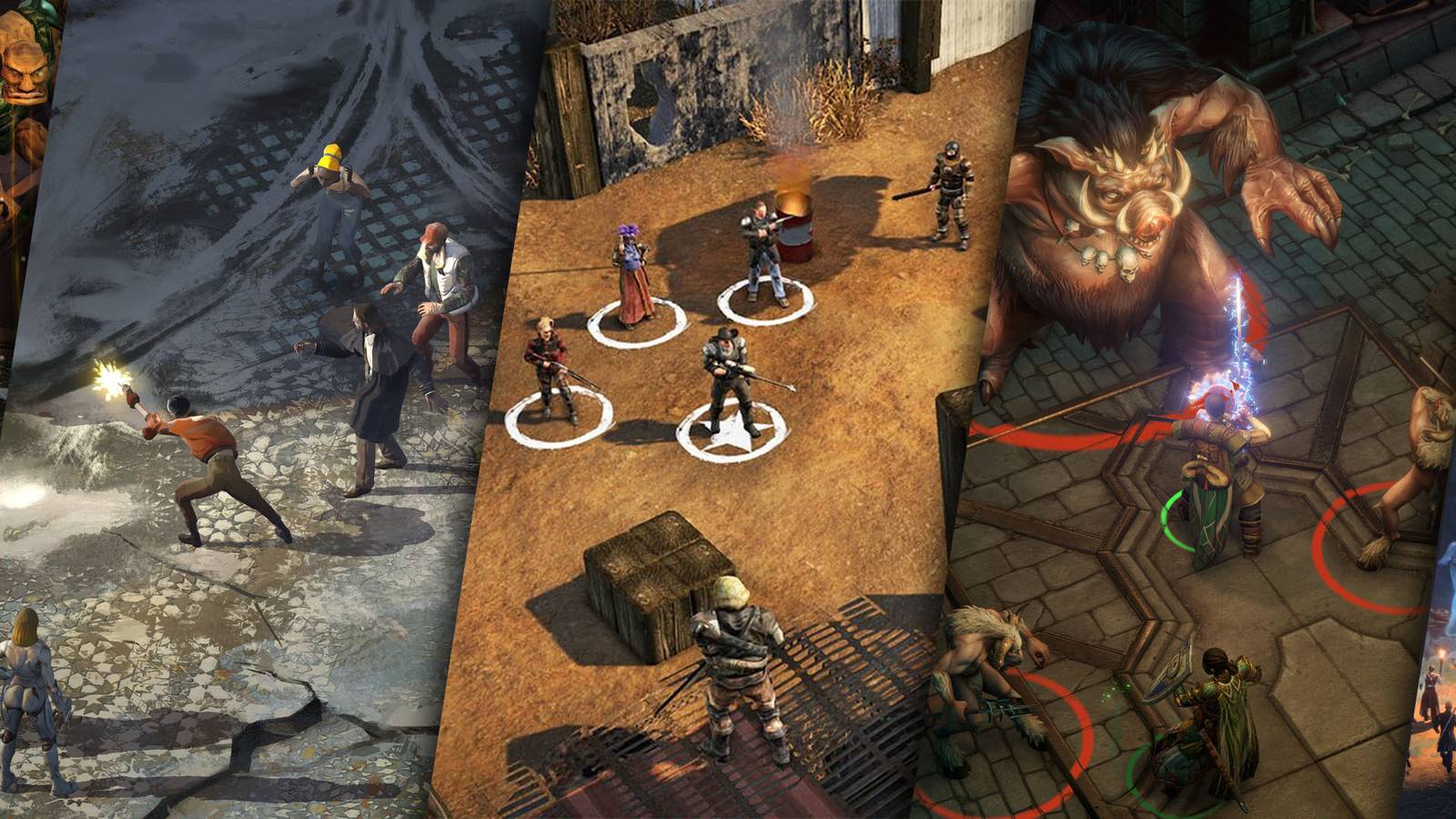
Isometric RPGs are a bit of a niche genre. While the more popular action and open-world RPGs dominate the headlines and the sales charts, isometric RPGs pull the camera back and give you a broader view of the game world. These more specialized role-playing experiences are built for a certain kind of player, one who loves reading long strings of text and doesn’t mind maneuvering through long lists of stats and ability effects to craft their perfect character build, or just to figure out how the new skill they unlocked actually works.

10 RPGs Other Games Still Copy
The RPG genre has been greatly influenced by these games that introduced features and mechanics still replicated today.
For those players, these next isometric RPGs are the cream of the crop. They are as close as the genre gets to being perfect. They aren’t always welcoming to genre newcomers, and some come with the caveat of being 10 or 20 years old, but from their storytelling to their world design to their unique takes on RPG mechanics, these are the games that any fan of the genre needs to clear out of their backlog.
Who’s That Character?
Identify the silhouettes before time runs out.
Identify the silhouettes before time runs out.
Easy (7.5s)Medium (5.0s)Hard (2.5s)Permadeath (2.5s)
10
Tyranny
Being Bad Feels Pretty Good

Tyranny

9/10
- Released
-
November 10, 2016

Tyranny is probably the least talked-about game to come out of Obsidian’s resurgence in the isometric RPG space, yet it is unquestionably the best of the bunch, even if Pillars of Eternity has expanded into a franchise of its own. Most RPGs give you the option to be a villain to some degree, but only Tyranny makes it the only option you have available.
As a Fatebinder in service to Lord Kyros, you travel to the last bastion of resistance in Vendrien’s Well and attempt to quell or quash any rebellion before it can gain ground. You can create a character and define their class as you progress, but the real draw is the companions. From a soldier who was fused with his suit of armor to a literal werewolf (called a Beastwoman), your party will always feature a group of standout characters. You can even define what serving Kyros means to you — whether it’s crushing dissent or merely manipulating events to your will — and your companions will respond appropriately. Meanwhile, your actions on Kyros’ behalf can lead to consequences that aren’t just unexpected; they will reshape the world around you in significant and often devastating ways.
9
Pathfinder: Wrath Of The Righteous
The Most Interesting Companions In The Biz
Speaking of companions, you’ll never have access to more of them, nor in a greater variety, than in Pathfinder: Wrath of the Righteous. Just at the base level, there is a massive roster of companion characters available for you to recruit. Each of them has a well-written personal quest that can play out in several different ways, not just based on your narrative choices, but also based on your choice of Path and character alignment. There are 19 of these standard companions that you’ll encounter throughout the 60+ hour campaign.
However, there are also hidden companions, DLC companions, and Path-specific companions that can only be recruited by meeting specific conditions. With 12 of these, this bumps the total number of potential companions to 31. Looking beyond the numbers, these are simply some of the coolest companions in any RPG out there, isometric or otherwise. There’s a dragon that will grow larger as you level up, eventually letting you ride her into battle. There’s a sentient weapon, an undead queen, a shapeshifter, a succubus, and more. You’ll be hard-pressed to find a more interesting squad of allies in a game of any kind.
8
Wasteland 2
Fallout For Sickos
If you’re looking for a dense RPG that rewards you for being detail-oriented and patient, then Wasteland 2 is right up your alley. While its more modern sequel, Wasteland 3, has a bit more quality-of-life polish, it lacks the passion present in W2. This is a love letter to CRPGs of the 90s and early 2000s, both embracing those old-school sensibilities while making just enough modern changes to remove the frustration that often plagued those older titles.
Stats are the name of the game here. Every gun type and piece of gear will alter your stats in some way. If you’re paying attention, you can craft some pretty potent builds, but winging it isn’t really an option. Combat is tense and deeply tactical, and the consequences of failure are steep. That goes double for skill checks and narrative choices made in conversations with NPCs. Your decisions have real weight in the narrative, and they will ripple out to quests that you take on 10 or 20 hours later, ensuring that you feel like an integral part of the world. Also, while there isn’t much voice acting in Wasteland 2, what is there is spectacular, further immersing you in this post-apocalyptic world.
7
Fallout
Trendsetters Never Go Out Of Style
It’s never easy to beat a classic, and Fallout is proof of why. Its sequel, Fallout 2, had a broader scope, much more side content, and many quality-of-life changes, but it lost much of what makes the original so special: storytelling, worldbuilding, and tone. Fallout is a linear experience at its core, but it perfectly captures the dark, moody tone that one would expect from a post-apocalyptic RPG.
Despite its age, getting immersed in Fallout happens almost instantly. The iconic “talking head” conversation system, coupled with a tough-but-fair turn-based combat system, keeps things moving at a steady clip. With only three timed main quests to deal with (albeit lengthy ones), Fallout is all about making you choose when you take action and how you can go about it quickly. If you don’t like in-game time limits, you can extend the quest timer through certain gameplay actions or install a mod to remove it entirely. While Fallout 2 does away with the time limit, its introductory hours are painfully slow, and the more humorous tone swings a bit too far from the dark and somber narrative of the first game. Plus, there’s no topping the Master as a final boss.
6
Warhammer 40,000: Rogue Trader
The Pinnacle Of Warhammer 40k Gaming
If you like your RPGs so dense and complex that you occasionally feel like you’re reading spreadsheets, then Warhammer 40k: Rogue Trader should be your next playthrough. As of this writing, it’s the most robust adaptation of the Warhammer 40,000 universe in any video game. The writing is excellent, the companions are all interesting, and the combat is deeply satisfying (once you get a handle on all the numbers that make it tick, that is).

Warhammer 40K: Rogue Trader’s Premise Explained
Warhammer 40K games usually position players in the role of the series’ iconic space marines, but Rogue Trader sidesteps this convention.
Rogue Trader is no weekend excursion; we’re talking a 100+ hour game here. However, the fact that it manages to pace itself perfectly for such a lengthy runtime is just another feather in its cap. It helps that combat never stagnates either. Even towards the end of the game, you’ll run into scenarios that force you to rethink how you utilize the game’s combat mechanics, pushing you towards constantly changing tactics rather than a go-to strategy. It’s also nice that, instead of playing a wandering nobody like in most RPGs, you play a titular Rogue Trader, tasked with expanding your empire and claiming your own portion of the galaxy. There are even space battles; what’s cooler than that?
5
Disco Elysium
Dissecting A Human Mind
For something completely different, look no further than Disco Elysium. This is an RPG with almost no combat, and even when you do get in a fight, it will be decided by dialogue choices and dice rolls, not turn-based battles or skill usage. The rest of the game is purely text-based, defined by how you build your version of amnesiac detective Harry du Bois.
Instead of traditional stats and skills, you have a handful of skills that relate to Harry’s different knowledge groups, divided into Intellect, Psyche, Physique, and Motorics. Each category contains six skills, and investing in them will enable Harry to take certain actions during the story. By exploring and conversing, Harry also unlocks Thoughts, which provide a boost to those skills and can also play into conversation choices. That’s Disco Elysium; it’s a hilariously experimental RPG where, instead of crafting a physical build for your character, you’re crafting their mind, and dealing with the inevitable fallout of those choices.
4
Divinity: Original Sin 2
Mechanical Complexity And Narrative Depth
When it comes to RPGs that nail both the narrative and gameplay aspects, few games can match what Divinity: Original Sin 2 offers. This is a robust, lengthy game with a ton of side content, branching quests, and detailed character-building systems that encourage both creativity and attention to detail. With a handful of set Origin heroes, you can experience the narrative through characters who are already deeply entwined with the world, although you can, of course, create your own hero as well.
There is plenty of opportunity to test out your wild ideas in the game world, both in terms of your build and any ideas you may come up with on the fly. Rivellon is incredibly reactive. Water makes surfaces wet, which makes anyone standing on them susceptible to electricity. Barrels of oil can be set on fire to explosive effect. Keeping a wizard on hand to cast weather spells is virtually essential, as it allows you to maintain control over the flow of the game’s turn-based combat. All this is just scratching the surface; the more you experiment, the more tricks you’ll add to your repertoire. It’s a phenomenal system that rewards you for your wildest ideas and makes you feel like you can use the world to your advantage.
3
Planescape: Torment
Not Your Grandaddy’s Fantasy RPG
There are really only two standout RPGs that put dialogue and NPC interaction at the forefront and combat on the back burner. Disco Elysium is one, and the other is Planescape: Torment. The game takes place on Sigil, a city sitting atop a tower found in the center of the multiverse, where all planes of existence converge. Sigil plays host to portals that connect these realms, acting as a sort of surreal crossroads for worlds both familiar and completely alien.

Beloved D&D RPG Almost Had a Sequel
A former Dragon Age writer reveals the extensive plans previously in the works to provide a popular Dungeons and Dragons game its sequel.
You play The Nameless One, an immortal zombie who has lived a thousand lives. Every time he dies, The Nameless One reawakens with virtually no memory of his past lives, and often with a completely new personality to deal with. This, naturally, lends itself to avoiding combat whenever possible, and nearly every potential combat encounter offers methods of resolving things without violence. Instead, it pays far more to stay informed, pay attention to character details and lore, and try to talk your way out of situations. Planescape: Torment is a weird game even by RPG standards, but there’s a reason it’s held up as one of the all-time greats. What it lacks in combat depth it more than makes up for in gripping, completely unique storytelling.
2
Diablo 2
Still The King Of ARPGs
In a sense, it’s surprising that the ARPG genre isn’t overloaded with different franchises trying to innovate and enhance its mechanical staples. Then again, it’s hard to innovate when Diablo 2 basically perfected the genre 26 years ago. Sure, other ARPGs have come since, even a pair of Diablo sequels, but while some have found ways to improve on one or two aspects, none have held a candle to Blizzard’s all-time classic dark fantasy game.
Whatever your RPG inclinations are, Diablo 2 has them. Build-crafting and class design are top-tier, especially once the Lord of Destruction expansion is taken into account. Combat is in a class of its own, and is still so sound that it can stand toe-to-toe with Diablo 3 & 4 and often outperform them. Even the story, while it’s not the main focus, is a standout element, featuring terrifying angels and demons alike locked in an eternal battle. Funny enough, the real highlight is the loot system, which constantly rewards you with new gear, weapons, charms, jewels, and more, all of which can instantly reshape your build or turn you into an overpowered demon-killing machine. Everything works in tandem, making for an addictive and engrossing RPG experience that still ranks among the greats all these years later.
1
Baldur’s Gate 3
The Peak Of The Genre
If there’s one CRPG that newcomers to the genre should gravitate towards, a game that has gripped both long-time RPG fans and people who have never played a video game before, it would be Baldur’s Gate 3. There really isn’t another game like it. Pulling from Larian’s past work with Divinity: Original Sin 2 and BioWare’s Baldur’s Gate games, BG3 is the quintessential Dungeons & Dragons video game, embracing and adapting the mechanics of 5e into something that anyone can not only enjoy, but can use to craft the most personal adventure they can experience outside a TTRPG.
When we talk about reactive game worlds, nothing comes close to Baldur’s Gate 3. Every decision you make, from character creation to offhanded remarks in conversation with an NPC, can influence the narrative and the setting. Even two years after its launch, players are still uncovering new secrets and interactions created by specific narrative circumstances. If you played Baldur’s Gate 3 at launch, it’s still worth a revisit. Larian released several updates over the ensuing months that added new dialogue options, new subclasses, an expanded ending, and even community-developed mods (available on all platforms) that can completely reshape a second (or third, or fourth) playthrough.

10 Flawless Turn-Based RPGs From The Last 10 Years
Experience the resurgence of turn-based RPGs with these modern masterpieces that have elevated the genre to new heights.
