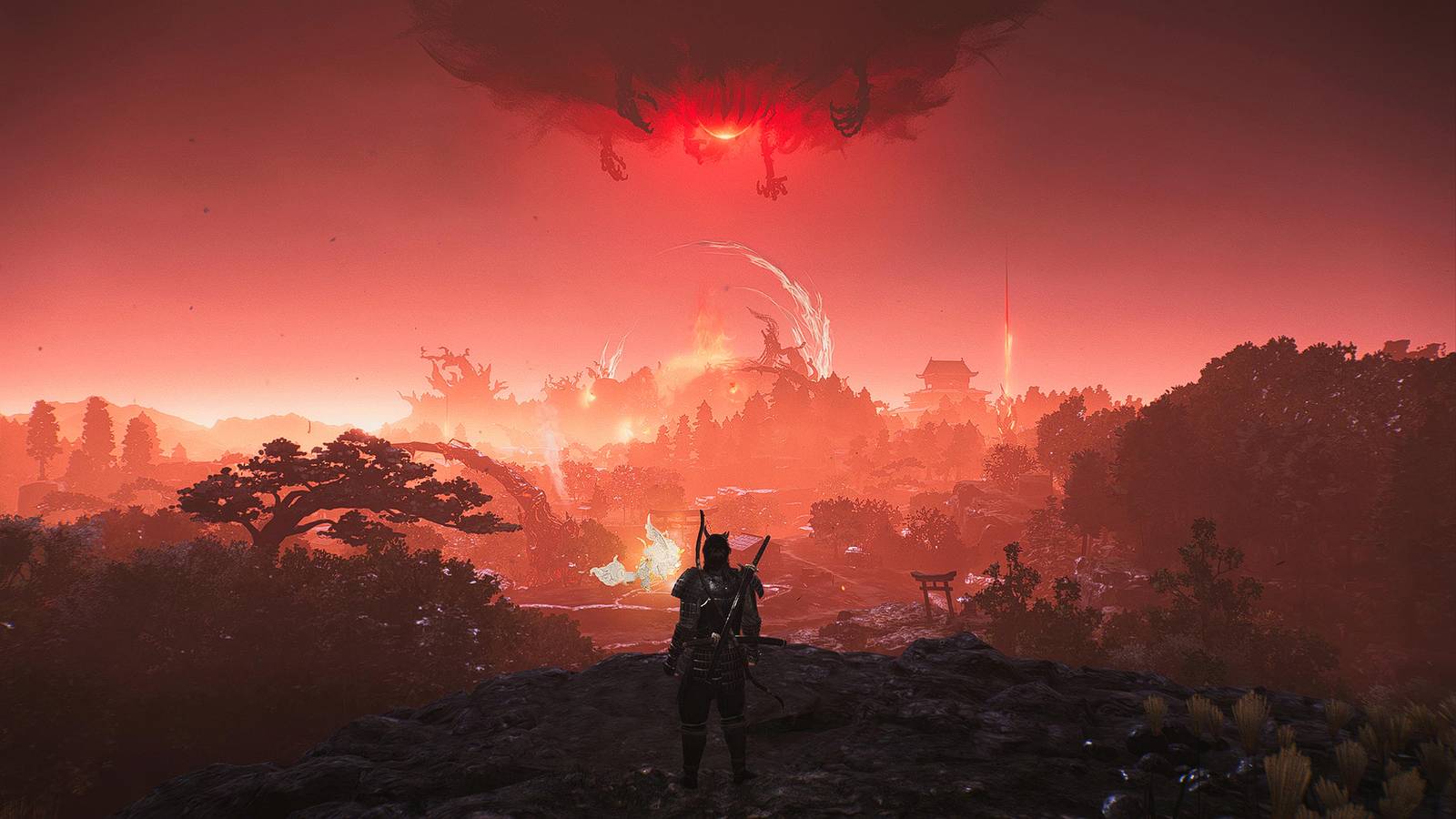
After all but breezing my way through the majority of Nioh 3‘s introduction, I was convinced the rest of the game would be a piece of cake. Its new Ninja style was not only already proving itself to be the perfect playstyle for me, but it made tackling the Souls-like’s rank and file feel like a walk in the park. Outsmarting my foes by evading their attacks in the blink of an eye or stealthily approaching them from behind and assassinating them for maximum damage, I felt invincible. It wasn’t until I encountered the opening number of Nioh 3‘s countless boss fights, though, that I hit my first major difficulty spike, and I realized I would need to treat this game with more respect than I initially gave it.
By and large, that proved to be my experience throughout the roughly 50 hours of my first 100% playthrough. As far as Souls-likes go, Nioh 3 falls more on the approachable side of things, but it never hesitates to humble you right when you’ve settled into a routine and its seemingly endless systems do take some time getting used to. While it isn’t fully open world, its open-field zones offer a fulfilling if familiar opportunity for exploration and discovery, and its seamless integration of that with the game’s various forms of progression make it a valuable centerpiece. All in all, I’ve enjoyed my time with Nioh 3 enough that I can’t wait to dive back into the New Game Plus run I’m currently on and finish it all over again.
Nioh 3‘s story keeps things fairly straightforward, using a time-spanning setup as an excuse to move players between several different periods of Japanese history. The world has been thrown into chaos by a supernatural force called the Crucible, which has begun bleeding across eras and unleashing yokai in its wake. Rather than treating those time periods as self-contained chapters, the game frames them as parts of the same ongoing conflict, with progress in one era carrying over into another. It’s not a story that demands your full attention at all times, but it does a good job of providing context and momentum as you move from region to region.
Movement Is the Name of the Game in Nioh 3
If there is one major takeaway I have from the dozens of hours I’ve poured into Nioh 3, it’s that this entry emphasizes movement more than any installment before it. In previous Nioh games, movement mattered, but it was grounded in samurai combat, meaning it was more about deliberate positioning, micro-adjustments, and careful management of space and stamina. In Nioh 3, however, its new Ninja style essentially turns that philosophy on its head, making speed and mobility a strength rather than a risk. In fact, Ninja often allows players to put enough pressure on the average enemy that they won’t even get a hit registered before they’ve perished.
Herein lies one of the biggest changes this entry makes to the series’ combat and build-crafting: Style Shift. With the new system, players can instantly switch between Samurai and Ninja playstyles, both of which are uniquely customizable with gear and skills. Samurai, of course, feels closer to traditional Souls-like combat, making use of heavy weapons, melee attacks, and Ki (stamina) management. Ninja, on the other hand, is a more agile combat style focused on ranged attacks, dodging, and Ninjutsu like poison-tipped shuriken. While there are in-combat benefits to shifting from one style to the other—like parrying an otherwise unblockable Burst Attack—I spent probably 98% of my time with the game playing in Ninja style alone. This is just one of the many ways Nioh 3 celebrates diversity in playstyle, and I was immensely grateful it never forced me to play a certain way.

Alongside the new Ninja style, stealth gameplay has rather fittingly been pushed to the forefront in Nioh 3, and it’s a very effective method for immediately eliminating weaker enemies or taking large chunks out of a stronger foe’s health bar. It can also be enhanced through various means to make it more effective, like making it harder for enemies to detect you or increasing your assassination damage. It’s not a perfect system, as I found it frustrating that a stealth attack would frequently alert numerous enemies in the area, even if they had no idea I was there to begin with. Nevertheless, stealth in Nioh 3 is viable enough that you can almost play it like Assassin’s Creed Shadows if you’re careful enough.
Of course, stealth doesn’t work in Nioh 3‘s boss fights, which are less challenging than your typical Souls-like boss but can still put up a decent fight if you’re not prepared for them or take them for granted. I personally appreciate that almost every single boss in the game only has one phase, as there’s nothing more demoralizing than thinking you’ve defeated a boss, only for it to be revived or transform into something far more powerful. That does make them more manageable by design, though I hesitate to flat-out call them “easy” because that ultimately depends on the player and their chosen build. However, they can be made even less demanding with the help of another player’s ghost, summoned via a Benevolent Grave—assuming you have enough Ochoko Cups to do so.
Nioh 3’s Open-Field Design Gives It a Sense of Discovery Past Entries Didn’t Have
Nioh 3‘s emphasis on movement goes beyond the new Ninja style, though, introducing what it calls an “open-field” experience that makes exploration a necessary component of progression. While Nioh 2 briefly explored multiple historical periods through linear time travel, Nioh 3 is the first entry to build its entire narrative around multiple eras existing in parallel and influencing one another. Within that framework, its open-field experience manifests in the form of several unique, visually stunning open-world zones with distinct biomes across time periods, each one giving players a new major boss to defeat until the main story has concluded. In a way, its approach to exploration feels similar to something like Final Fantasy 7 Rebirth‘s open-world zones, which comes with a handful of both pros and cons.
Exploring every nook and cranny of Nioh 3‘s world is absolutely essential if players want to get the most out of the experience. There are countless upgrades, both gear and otherwise, that can be found off the beaten path, so ignoring them is a great way to make the game more difficult than it needs to be. Optional bosses might drop valuable gear sets or Soul Cores that can be used to summon them, completing certain open-field activities can award blessings that offer passive buffs like Elixir (health potion) drop rates and efficiency, and there are plenty of skills that can only be acquired through means other than the main story. All of this and more, plus the fact that Nioh 3‘s world is beautiful to look at, makes exploration a worthwhile venture.
However, where this part of the game drops the ball a bit is in how repetitive its exploration is. As players explore each region of an open-field zone, they can increase their Exploration Level by completing major activities like finding shrines, opening chests, and capturing enemy bases. As the Exploration Level of that region increases, players gain several advantages like items and increased base stats, and the map can eventually be upgraded to display the location of collectibles and various points of interest. What this means, though, is that by the time players have reached a region’s maximum Exploration Level of 4 (which is quite easy to do), their map will begin to be inundated with icons, and what once felt like curiosity-driven discovery transforms into a checklist of to-dos.
Exploring every nook and cranny of Nioh 3‘s world is absolutely essential if players want to get the most out of the experience.
I will say that I was less tempted to rely on the map in Nioh 3 than I generally am in most open-world games, as its world is designed to pique your curiosity just by looking at it, so that does put a big enough bandaid over the icon fiasco to ignore it. But that doesn’t help the repetitive nature of the game’s open-field design. It was nice that each time period introduced a new biome and new enemies, but everything else almost felt like Mass Effect Andromeda to an extent, where each planet was just more of the same with a different skin. That being said, after taking a brief break from Nioh 3 and then coming back to it at one point, exploration felt fun and fulfilling again, and I never felt exhausted with it after that.

Outside its role in Nioh 3‘s story, the Crucible also functions as a dedicated gameplay layer that gates progression between each major region. Every time you enter a new era, you’re eventually taken into a Crucible sequence that serves as a kind of pressure test, complete with its own rules, enemy setups, environmental hazards, and a major boss encounter at the end. These sections crank up the intensity by limiting your margin for error, throwing denser enemy groups at you and forcing a different level of awareness than the open field generally requires. Beating a Crucible doesn’t just move the story forward, but actively weakens its influence on that time period, giving each one a clear sense of closure before you move on. It’s a smart way to break the game into digestible arcs, and it helps ensure that progression never feels arbitrary.
Nioh 3 also features Crucible weapons that are more powerful than standard weapons but come with the trade-off of enforcing Crucible rules like Life corruption on the player.
Similarly to a game like Star Wars Jedi: Survivor, Nioh 3 does ask you to return to previous time periods regularly if you want to complete and collect everything in the game. This entry brings back the series’ staple Guardian Spirits, many of whom unlock unique traversal abilities that will allow you to reach areas you couldn’t reach before. I do enjoy this form of metroidvania-like exploration in games, and I didn’t mind it in Nioh 3 either. However, when there’s no real purpose behind it other than checking another thing off the list, it feels a bit gimmicky. A saving grace for this, at the very least, is that each Guardian Spirit also offers players passive buffs and combat abilities that can help maximize the effectiveness of their build.
Nioh 3 Is a Build-Crafter’s Dream
While its Ninja style and open-field exploration are undoubtedly two of its most notable features, where Nioh 3 truly shines brightest is in its build-crafting. This is one of the few Souls-like games I’ve played where I felt like the sky really is the limit when it comes to possible build combinations, and a lot of that comes down to the insane amount of equipment players can find as they explore each region and defeat the numerous enemies that inhabit them. During my 60 hours or so of total playtime, I would estimate that I’ve collected well over 10,000 pieces of gear, each with a random set of passive traits that can either help or hinder the build I want. That might be yet another staple of the Nioh series, but Nioh 3 takes it to the next level.
Nioh 3 allows players to have up to 2,000 items in their inventory at one time, allowing for long stretches of gameplay without the need to sell or dismantle things to free up space. It also has extensive filtering options for batch-selling, dismantling, or exchanging for Amrita (souls), with the ability to select all items of a certain rarity or level, among many other things.
That abundance of loot feeds directly into how expressive Nioh 3‘s build-crafting ultimately feels. Weapons, armor, accessories, Guardian Spirits, Soul Cores, Titles (challenges that offer unique buffs upon completion), and passive bonuses all stack on top of one another in ways that feel like they actually change how encounters play out, not just how high your damage numbers climb. It’s one thing to see marginal stat gains on a character sheet, but it’s another to feel a build come together in real time, whether that means poison procs triggering more frequently, assassination damage skyrocketing, or Ki recovery allowing you to stay on the offensive far longer. Even small adjustments, like swapping out a single armor piece or rerolling it at the blacksmith, can noticeably change the tides of battle.

But what really takes Nioh 3‘s build systems up a notch is in how it incorporates its two distinct Samurai and Ninja playstyles into the mix. Ninja-focused builds naturally lean into Ki recovery, Ninjutsu, damage over time, and other mobility-enhancing effects, while Samurai-oriented setups focus more on raw power, survivability, and Ki efficiency. Hybrid builds are not only viable but encouraged, particularly thanks to Style Shift, which allows players to experiment without feeling locked into a single approach. And it’s even easier to experiment with builds in Nioh 3 thanks to limitless, free stat and ability refunds.
I frequently found myself tweaking my equipment set between regions or boss fights, not because the game demanded it, but because it felt rewarding to see how far I could push a particular idea. In the end, I had a Ninja-based, Onmyo Magic-Ninjutsu build that let me put enough pressure on enemies to keep most of them from even being able to act, all while my damage-over-time attacks whittled away at their health bars and I stayed beyond their reach. It honestly felt a little broken when all was said and done, but it’s important to note that I didn’t reach that point overnight, as it took a lot of experimentation, trial and error, and sifting through countless pieces of gear and gear sets to find what I wanted to work with the most.
Nioh 3 Raises the Bar for What Nioh Can Be

Ultimately, Nioh 3 feels like a confident step forward for the series, expanding player freedom through its Ninja style, Style Shift system, and deep build-crafting without losing what makes Nioh work. While its open-field design can lean on tired ideas, it rarely drags the experience down, and the game’s combat is the strongest it has ever been. I enjoyed my time with Nioh 3 enough to immediately jump into New Game Plus, which says a lot on its own, and I’m looking forward to seeing how things play out now with the increased difficulty and customization options it offers. It also helps how well the game runs on the PS5, where it has performed smoothly for me from start to finish with no technical issues to speak of. For longtime fans and newcomers alike, Nioh 3 proves that the series still has room to grow, experiment, and surprise.
Nioh 3 launches on February 6, 2026 for PC and PS5. Game Rant was provided with a PS5 code for this review.
