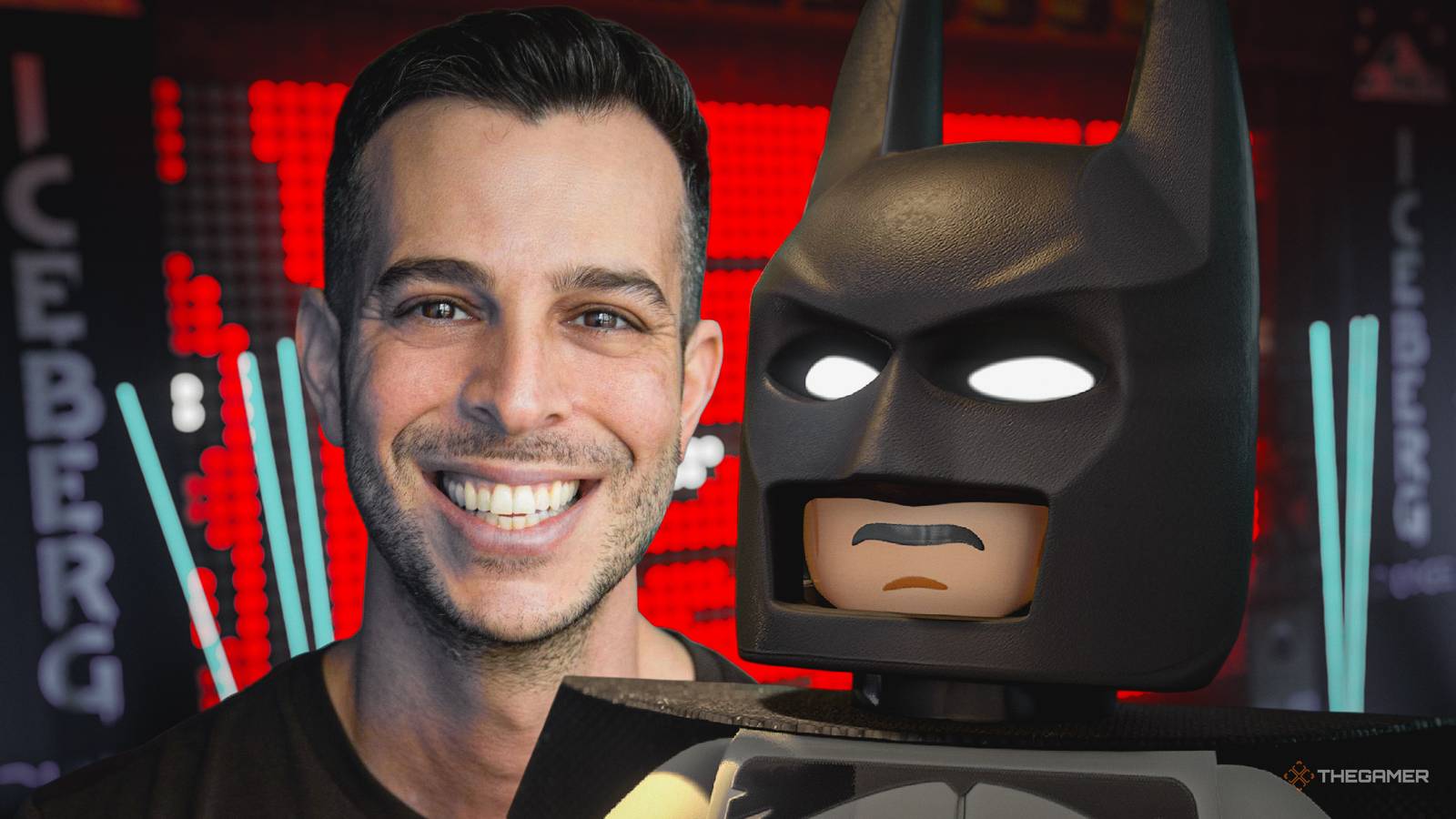
Shai Matheson, the voice actor behind Batman in LEGO Batman: Legacy of the Dark Knight, doesn't talk about the role as much as he steps into the character. He talks about it like walking into a room furnished with decades of repetition and devotion, and then being asked to enter quietly, without knocking anything. Which, in its own way, is what the game asks of him.
The game tries to do something complicated without seeming like it's trying too hard: compress nearly a century of tonal contradictions and conflicting story arcs and adaptations into a fun and still recognizable Batman. The result is a version of the character that doesn't land on a single interpretation so much as hovers between them, as if every previous Batman is echoing from the same cowl.
Looking for a Batman made of all the Batman voices and none of them

For Matheson, that ambiguity was the assignment. “It was kind of a collaborative effort with the team from TT and myself, but I think 'mixed' is the right description,” he says. “I grew up watching the films over and over again. I'm such a big fan, you can see,” he adds, gesturing towards the Batman memorabilia that adorns his zoom background. “Those movies have always been in the back of my mind. They're part of my being.”
That lifelong familiarity meant that finding a voice wasn't really an exercise in imitation, but an instinct. Matheson says he actively tried not to sound like any previous Batman, though he soon realized how impossible that was when a character had existed in the public consciousness for more than 80 years.
“And guess what [the developers] Loved that [my Batman] It was neutral in a way,” he says. “It was all Batman's voice and none of Batman's voice.”
TT Games' Lego adaptations have always existed somewhere between parody and homage, but this project in particular emphasizes Batman's ability to incorporate every version of himself at once. The game follows Bruce Wayne over a 20-year arc, meaning Matheson had to voice not one Batman, but multiple Batmans — both as a character at different stages of Batman's development and as a character we've seen filled with different specific actors over the decades.
“My boy goes from being a young Bruce Wayne, full of vengeance, to those 20 years as a legend,” he says. “And so, we had to go through that journey vocally as well.”
The pressure of playing Batman is already in their heads

The role comes with inevitable pressures: Batman fans are famously very casual and relaxed about new interpretations of Batman. “I mean, I'm a Batman fan myself,” Matheson says. “You know, I have my favorite. And it's usually the one that kind of hooks you, right? It's whoever you are, whether it's the first Batman you fall in love with, that's going to be your favorite forever.”
Every new Batman actor is essentially signing up to enter one of the longest-running, most deeply intractable arguments on the Internet. Somewhere, always, someone is arguing about a certain Batman. Matheson is well aware that there are performances that have practically owned a character for entire generations.
But in a way, video games settled this debate. The most animated and virtual portrayals of Batman since the 90s were voiced by Kevin Conroy. Regularly praised for his work in the role, Conroy passed on in 2022, but his final turn came posthumously in Suicide Squad: Kill the Justice League. Legacy of the Dark Knight marks the first major appearance of the bat in games without Conroy in some time, which puts even more pressure on Matheson's shoulders. “I'll never be Kevin Conroy, will I?” He says. “Who's going to be Kevin Conroy? Nobody. I'm never going to be Troy Baker. I'm going to be a version of me.”
But Legacy of the Dark Knight doesn't seem to want Conroy's rendition, or any of the film versions, to turn it into a straight parody. Instead, it considers Batman to be elastic. The character survives reinventions because he has always embodied contradictions: gothic noir detective, camp comedy figure, traumatized vigilante, toytic blockbuster icon.
“There's no answer,” Matheson says when I ask him where he falls in the long-running debate about whether Batman works better as dark realism or comic-book silliness. “He could be all of those things. I think that's why the character lasted 86 years.”
That flexibility is especially evident in The Lego Game, where slapstick comedy and big emotional beats exist with villains like the Condiment King. “We're doing a love letter to Batman as a comedy,” says Matheson. “But we have some dark elements, you know, some serious moments in our game. It's not all frivolous because there has to be some truth.”
For him, part of the fun came from treating Batman as a straight man in a comic world. “Comedy for me is this serious character, while everyone around me is silly,” he says. “And to me, 'We have a mission, this is serious.'
At the end of our conversation, I ask him about something a little bigger than his performance: the possibility that, for young players, this version could be their Batman. “I remember how it felt and what a privilege it was to entertain,” he says, “and just to think that my version of Batman will be some kid's first Batman.”
It's still real to him, he admits, but perhaps more fitting for a character who has spent decades accumulating explanations rather than replacing them. Batman doesn't really belong to one person, or one era, or one interpretation for a long time. LEGO Batman: Legacy of the Dark Knight isn't trying to define a certain Batman; It adds another voice to the chorus.
