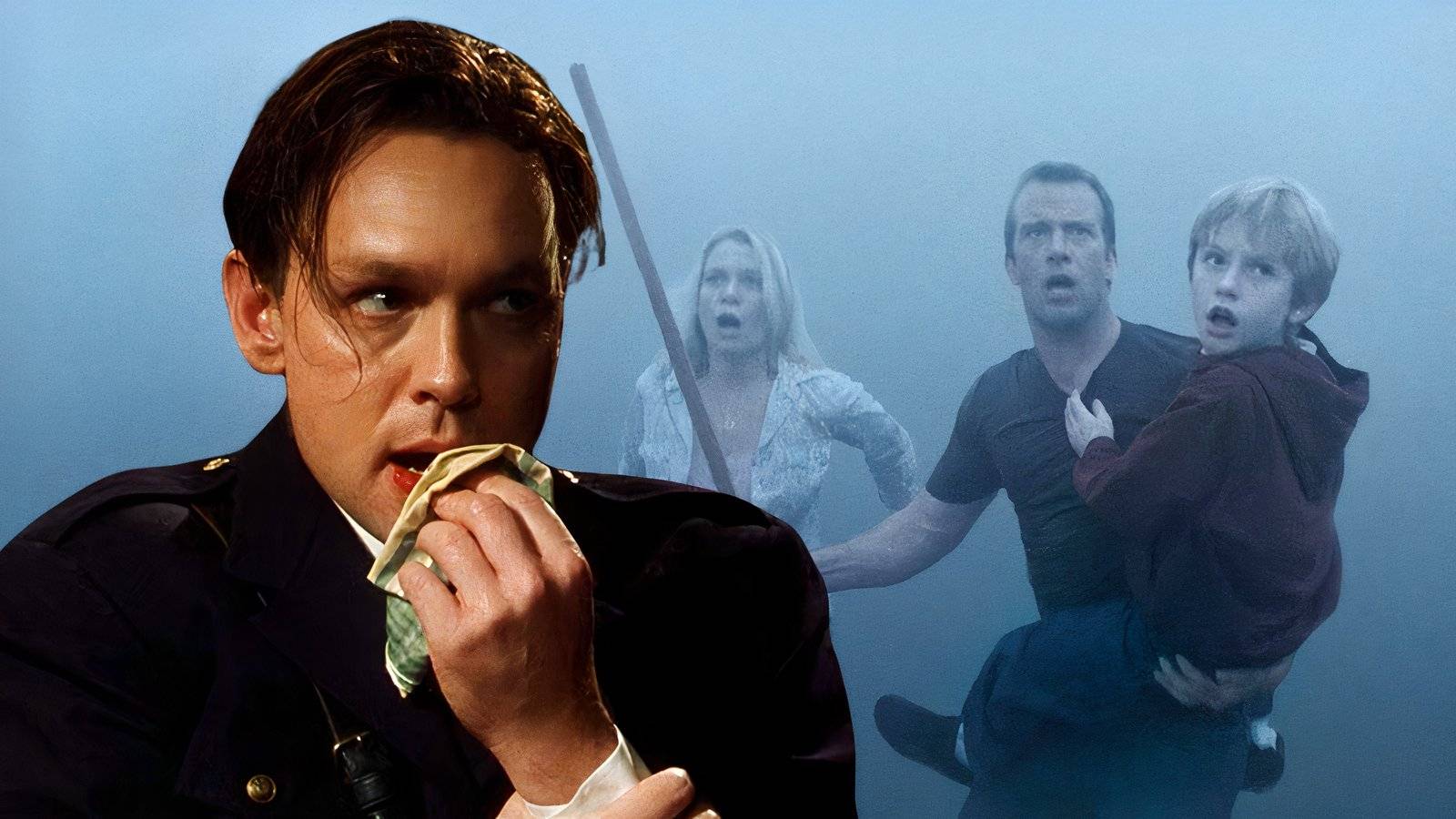
Stephen King is undoubtedly the master of modern horror literature, crafting nightmarish monsters, shapeshifting cosmic entities, and supernatural demons across more than 60 novels, novellas, and short-story collections. But his greatest creations aren’t always the things lurking in the dark. Some of his most memorable villains are much more recognizable: abusive parents, petty bullies, obsessive fans, fanatical believers, and ordinary people who discover just how much damage they can do to the people around them.
That’s part of what makes choosing the best King villains so difficult. There are plenty of monsters to choose from, but King has always understood that the most frightening villains don’t necessarily look frightening at all. Some are supernatural embodiments of evil, while others work so well precisely because you could imagine meeting them in real life. So, after narrowing down decades of monsters, murderers, and malevolent forces, these are 10 of the greatest villains to have escaped from Stephen King’s imagination.
10
Percy Wetmore
The Green Mile

A recurring type of villain in Stephen King’s books is arguably more frightening than the Machiavellian, supernatural puppetmasters who operate behind the scenes: the sadistic, cruel idiots who seem to have wandered into the story from real life. You can find them in Ace Merrill in The Body, Henry Bowers and Patrick Hockstetter in It, and The Kid in The Stand. They are potentially more frightening than the suave supernatural villains because they feel grounded in reality.
Percy Wetmore is one of the death-row guards in The Green Mile, and it’s a testament to King that Percy is the most repellent character in a book featuring numerous condemned murderers. He’s only hired because of nepotism, and he constantly uses his connections to coerce and threaten Paul Edgecomb and his colleagues whenever they refuse to indulge his behavior. He is a spiteful, petty bully, whose stupidity is only exceeded by his mean streak. His most vicious act comes during an execution, when Percy deliberately leaves the sponge dry on the electric chair. Without the water to conduct the electricity properly, the inmate suffers a prolonged, agonizing death; one of the cruelest acts in the novel is only made worse by the fact that Percy has no grand ideology or twisted philosophy behind it. He does it because he wants to hurt someone.
This is what makes Percy such an effective villain. He isn’t charismatic or particularly intelligent. He’s just a horrible person who has somehow been given authority over other human beings. In The Green Mile, which examines the morality of the death penalty and the humanity of prisoners and guards alike, Percy represents the possibility that the guards can be more monstrous than the person sitting in the cell.
9
George Stark
The Dark Half

The Dark Half is an often overlooked King book, but it is also one of his most strangely autobiographical. Its protagonist, Thaddeus Beaumont, is a respected literary novelist whose more successful but considerably pulpier crime novels are published under the pseudonym George Stark, mirroring King’s own pseudonym: Richard Bachman. When Thad “kills” George Stark as part of a publicity stunt, he discovers that his fictional alter ego isn’t quite as fictional as he thought.
Stark gains a corporeal form and begins hunting down everyone who knows the truth about his identity, violently killing anyone who gets in his way. Stark is one of King’s more inventive villains; he’s not just trying to kill Thad, but systematically trying to destroy Thad’s life, family, and reputation. Stark is effectively Thad’s worst impulses incarnate, making The Dark Half‘s central conflict feel like a battle against a monstrous version of the protagonist himself. He is also a surprisingly vulnerable villain. Stark isn’t omnipotent or immortal, and his physical condition begins to deteriorate as the story progresses. His desperation to stay alive makes him increasingly unpredictable and much scarier as a result.
8
Brady Hartsfield
Mr. Mercedes

Brady Hartsfield, the sadistic antagonist of Mr. Mercedes, is a disquieting villain precisely because there is nothing supernatural about him. He is a product of the modern world, hiding behind an ordinary face and the anonymity afforded by technology and internet chatrooms. From the outside, he’s a nice-looking young man who can walk down the street unnoticed: personable, mild-mannered, and helpful, and altogether the last person you would suspect of deliberately driving a stolen car into a crowd of innocent people.
Beneath Brady’s ordinary exterior, though, is a deeply troubled individual, with much of his behavior tied to his dysfunctional relationship with his mother and the guilt surrounding the death of his younger brother. He’s intelligent, manipulative, and fascinated by the people affected by his crimes, making his actions feel disturbingly personal.
Mr. Mercedes is more of a crime thriller than one of King’s traditional horror novels, but Hartsfield demonstrates that King doesn’t need supernatural powers to create genuine terror. King has created plenty of monsters over the years, but Brady is frightening because there is no monster hiding underneath the mask. The mask is the monster: an ordinary human being whose calculated cruelty and disregard for human life make him one of King’s most unsettling villains.
7
The Overlook Hotel
The Shining

Now, it might seem strange to include the Overlook Hotel on a list of villains, and not Jack Torrance, but in the novel at least, Jack is more a victim than a villain. The Shining movie famously turns Jack Nicholson’s performance into a chaotic descent into madness, but King’s Jack is considerably more tragic. He is an alcoholic with anger issues, resentment, and deep insecurities, but he spends much of the novel fighting against the influence of the hotel rather than willingly embracing it.
The hotel, though, is a different story. More than just a haunted building, it feels like a living, malevolent presence, a place saturated with accumulated violence and people’s suffering. It knows exactly how to get inside Jack’s head, exploiting his alcoholism, temper, frustrations with his family, and insecurities about his failures as a husband and writer. Rather than simply possessing him, it finds the pressure points and cracks that already exist and gradually widens them.
That’s what makes the Overlook such an effective villain. It doesn’t need to create Jack’s weaknesses; they were there already. It simply gives him a little push. The hotel isolates the Torrance family from the outside world and slowly convinces Jack that his family is the obstacle standing between him and everything he wants. Jack’s eventual violence is horrifying without making him a straightforward villain. The horror comes from watching a decent but deeply flawed man lose himself, as he is turned against the people he loves.
6
Annie Wilkes
Misery

As with many of King’s villains, Misery‘s film adaptation arguably made Annie Wilkes more sympathetic than she is on the page. Kathy Bates’ Oscar-winning performance gives Annie a vulnerability and an almost childlike quality that makes her feel, at times, more pitiable than monstrous. King’s Annie is considerably more grotesque, volatile, and frightening, and the novel makes it much clearer just how completely trapped Paul Sheldon is.
Annie begins Misery as Paul’s apparent savior, rescuing the injured author after a car accident and taking him back to her isolated home to recover. Paul soon discovers that she is his biggest fan, but also that she is dangerously obsessed with his novels. The infamous “hobbling” scene is a particularly brutal reminder of what Annie is capable of, and it is even nastier in the book, where she cuts off Paul’s foot rather than merely breaking it with a sledgehammer. But the violence is only part of what makes Annie such an effective villain. Her real weapon is unpredictability.
Annie’s mood can change without warning. One moment, she is excitedly discussing Paul’s new manuscript, and then she is screaming at him for some minor transgression. Sometimes, she becomes frighteningly still, wandering around the house in a daze before calmly announcing that she will have to kill him. Paul never knows which version of his “Number One Fan” he is going to encounter or what might provoke her next outburst. Annie is one of King’s best and most terrifying villains precisely because she is so human. She is just an obsessive, deeply disturbed woman with enormous power over a helpless man, and her capacity for violence is matched only by her ability to convince herself that everything she does is justified.
5
Pennywise
It

Pennywise the Dancing Clown is perhaps the most iconic Stephen King villain, but there is a common misconception about the character, particularly among people who know the story primarily through its film adaptations. Pennywise is not really the villain’s true form. He is merely one manifestation of an ancient shapeshifting entity, referred to by the Losers’ Club as IT.
In King’s novel, IT can take on almost any shape, choosing forms designed to prey upon its victims’ deepest fears. At various points he appears as a werewolf, a zombie, a vagrant suffering from leprosy, a giant bird, a swarm of flying leeches, and some incarnations that words can’t really describe, while its true form is something so alien that human beings can barely comprehend it. Pennywise is simply the face IT chooses most often when preying upon the kids in Derry.
This ability to constantly change shape is what makes IT such a good villain. The horror isn’t just that there is a monster hiding beneath the clown’s makeup; it’s that the monster can become almost anything. A clown, a sewer, a balloon, or even a familiar voice can all become terrifying when there’s an ancient entity underneath capable of turning its victims’ own fears against them. Of course, the fact that it seems so cheerful about the prospect of eating children makes the monster infinitely creepier, taunting the now-grown protagonists as they return to Derry.
4
Mrs. Carmody
The Mist

The best thing about The Mist is the way that the eldritch horrors that are trying to get into the supermarket are only marginally more dangerous than the incendiary situation unfolding between the survivors within. As an eccentric woman, Mrs. Carmody is typically someone the town residents avoid, but when the mist descends, the locals all find themselves in close quarters, and nobody can avoid her for long. As The Mist begins suggesting there are literal monsters outside, she manages to attract a confused and scared contingent of the survivors, desperate for some kind of explanation for the chaos around them.
Carmody provides one: She interprets the disaster through her own religious beliefs, presenting the monsters as evidence of divine punishment and herself as someone capable of explaining what needs to be done. Before long, she has transformed into the leader of a growing group of fanatics, calling for expiation and attempting to sacrifice those who refuse to believe her. Carmody represents one of King’s most unsettling forms of evil: the ordinary person who discovers that fear gives them power. The Mist isn’t just about humanity being threatened by creatures from another world; it’s about how quickly a frightened community can turn against itself.
3
Rose The Hat
Doctor Sleep

Rose the Hat is simultaneously one of the most downright creepy villains in King’s books and one of the most personable. She is proof that King can make an antagonist unsettling without making her conventionally monstrous. In fact, Rose’s ability to appear charming and approachable, with her quirky festival attire, is one of the things that makes her such a disarming villain. As the True Knot’s leader in Doctor Sleep, Rose travels across America with her group in search of victims possessing “the shining” and feeds on the psychic essence released as they die.
Rose is intelligent, confident, and charismatic, with an almost effortless ability to make herself seem trustworthy. She’s also capable of genuine warmth toward True Knot members, which only serves to make the callous treatment of their victims all the more disturbing. She isn’t simply a monster who kills for fun; she’s a genuine predator, and that’s so much more frightening.
Rose’s pursuit of Abra Stone also gives Doctor Sleep a villain who feels matched by her opponent. Both Rose and Abra possess extraordinary psychic abilities, turning their conflict into something more than a straightforward chase. Rose understands the nature of the shining and knows how dangerous someone like Abra can be, while Abra represents a kind of power and potential that Rose desperately wants for herself. As with George Stark, it’s this small-scale mission, and her oh-so-human desperation, that makes Rose all the more scary. She is intently hunting one specific girl simply because she’s hungry.
2
Mr. Barlow
Salem’s Lot

Tobe Hooper’s Salem’s Lot made a lot of changes from the novel, not least of which was the head vampire’s characterization. Hooper’s version of the elusive Mr. Barlow is a feral, Nosferatu-inspired creature; a primal evil who communicates through hisses and guttural snarls. The book’s Barlow is vastly different, as King portrays him as a charming, solicitous, and disarming variation on Dracula.
The novel itself is consciously styled as a modern version of Dracula, and Barlow is very much its modern equivalent. Far removed from the seductive vampires of romance fiction, Barlow is an ancient, predatory, and utterly ruthless villain who arrives in Jerusalem’s Lot with the intention of turning the entire community into his feeding ground. And yet his methods are surprisingly subtle — he merely approaches the townsfolk and eases them into a false sense of security with his calming, hypnotic voice, until they welcome his teeth on their neck. It’s much more subversive than the archness of the original Dracula novel, and he eventually transforms their entire community into a place where nobody can feel safe. Neighbors, friends, and family members attack one another, while the small town’s familiar, idyllic setting gradually turns into a nightmare.
Barlow works particularly well because he embodies the cold, relentless nature of traditional supernatural evil. Like Rose, he is a predator, and the people of Jerusalem’s Lot are his prey. Considering Salem’s Lot deliberately plays with Dracula conventions, King uses Barlow to strip away the romanticism surrounding the traditional vampire and return the creature to something cold, ruthless, and genuinely frightening.
1
Randall Flagg
The Dark Tower, The Stand, The Eyes of the Dragon, many more

There’s not really any other option for the number one spot than the Man in Black himself. Randall Flagg is one of King’s most enduring villains, appearing in different forms across multiple stories and becoming one of the clearest recurring embodiments of evil in his interconnected universe. Whether he’s Randall Flagg, Walter O’Dim, or another incarnation, he embodies the idea that evil is a constant, persistent, and inevitable presence.
In The Stand, Flagg appears as a supernatural figure who watches civilization’s collapse and exploits survivors’ insecurities and vulnerabilities to establish his own brutal society. He’s a truly malevolent, sadistic character, offering people power, belonging, and purpose while building a world based on fear and obedience. Even when his plan fails, Flagg treats defeat as little more than a temporary inconvenience. His schemes are centuries in the making, so he is perfectly willing to start again somewhere else.
Flagg’s eerie combination of charisma and cruelty makes some of his scenes particularly memorable, and he relishes terrifying his victims. The moment he taunts henchman Bobby Terry before tearing him to pieces is one of the nastier moments in a very nasty book. But Flagg becomes an even more significant villain in The Dark Tower series, where he serves as Roland Deschain’s nemesis. The series introduces him with one of King’s most famous opening lines: “The man in black fled across the desert, and the gunslinger followed.” From there, Flagg becomes part of the much larger mythology surrounding Roland, the Dark Tower, and the different worlds connected to them.
HEY BOBBY TERRY YOUUUUUU SSSSCREWED UP!!!
What makes Flagg particularly compelling is that he doesn’t simply destroy things from the shadows. He gets people to willingly follow him. His appearances in many of King’s works give him the feeling of an evil that keeps returning in different forms, and fans have often theorized he appears elsewhere, including as Carrie’s father in Carrie, He Who Walks Behind the Rows in Children Of The Corn, and Leland Gaunt in Needful Things. He’s not tied to one town, one monster, or even one story. He’s a recurring force of chaos and malevolence who can turn up anytime.

- Birthdate
-
September 21, 1947
- Birthplace
-
Portland, Maine
- Notable Projects
-
The Shining, Cujo, The Shawshank Redemption, It, Carrie
