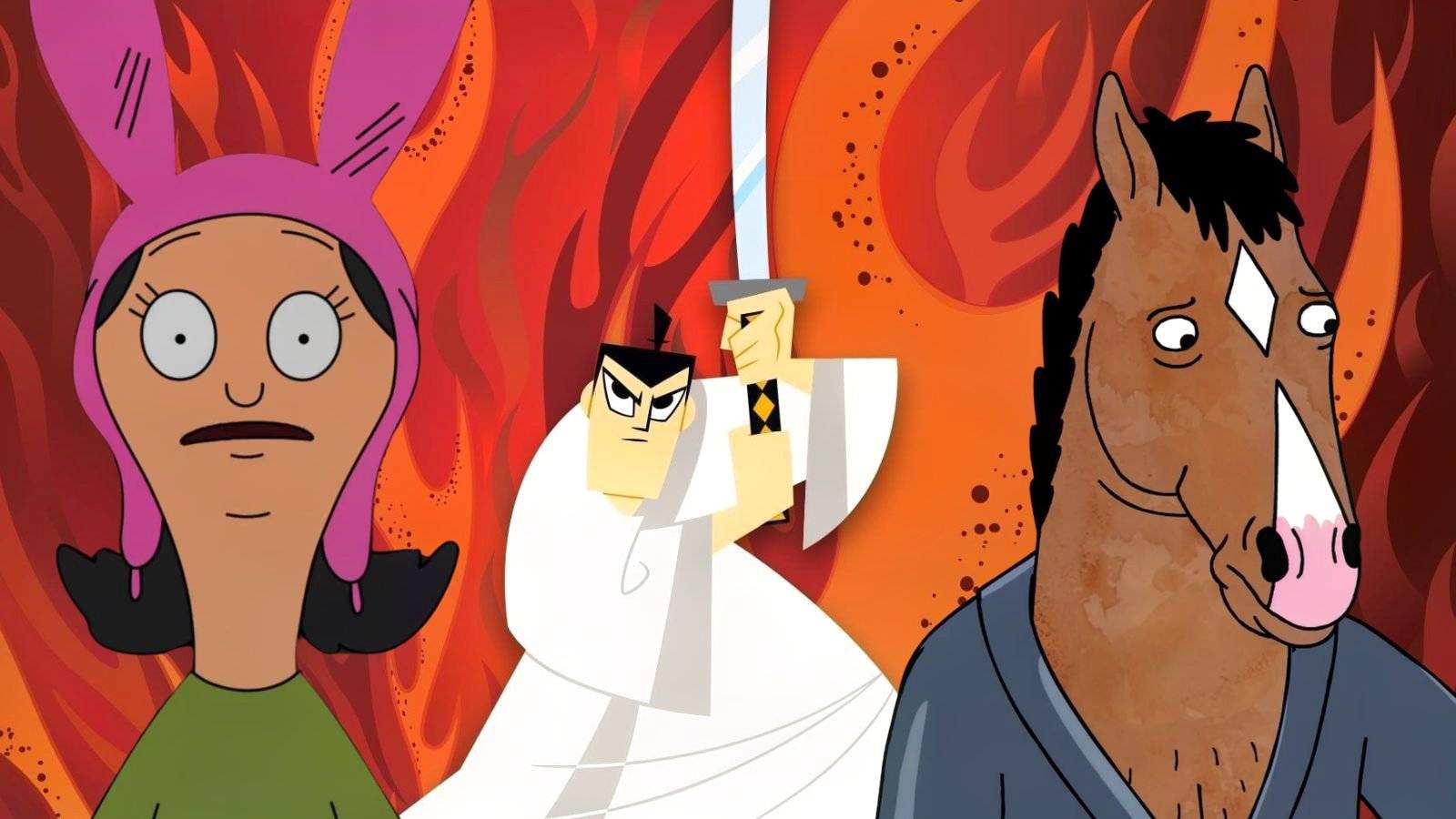
When it comes to elite television shows, many audiences’ minds will jump to cultural phenomena like Breaking Bad or The Sopranos. Animation is rarely taken seriously as a genre, and few animated shows ever make it onto a “best of” list. But this idea couldn’t be further from the truth, and there are plenty of elite animated TV series out there with plenty to offer both children and adults.
One of the biggest reasons why some animated shows have been able to pull off a nonstop perfect run is the fact that the teams behind these cartoons are able to expand their central concepts in ways live-action shows cannot. Whether it’s a wholesome sitcom about a blue-collar family or a story about a samurai prince’s adventures, animated shows are just as capable of impressing audiences as live-action TV. So, to highlight the best of the best in TV animation, here’s a list of the seven animated series that never had a bad season.
7
Phineas and Ferb
6 Seasons

2007 was quite the year for animated premieres, as soon-to-be household giants like Total Drama Island and Chowder made their way into the mainstream. However, despite the competition, Phineas and Ferb stood out from the pack thanks to its fun premise and colorful cast of characters. The show originally aired as an 11-minute preview segment on Disney Channel after the premiere of High School Musical 2. “Rollercoaster” acted as a sneak peek and managed to achieve Disney Channel’s second-highest-viewed telecast, with over 10.2 million people tuning in to watch the short. Its popularity then spiraled into a full-blown season that debuted one year later on February 5, 2008.
Phineas and Ferb follows the various wildly chaotic adventures of the titular stepbrothers as they try to make the most of their summer vacation. This wonderfully simple premise turns kids hanging out in their neighborhood into a fantastical spectacle, as the titular characters conceive elaborate, wondrous inventions like a literal time machine or an “infinite probability generator,” much to their sister’s dismay. When Phineas breaks out his signature catchphrase (“Ferb, I know what we’re going to do today!”), audiences know they’re in for a fun ride. The series also focuses on the playful rivalry between a secret agent platypus and a bumbling evil genius who’s hell-bent on taking over the tri-state area.
Phineas and Ferb never runs out of fun ideas, even though its episodic formula could’ve easily become boring or drawn out. There’s plenty of smart, witty dialogue for adults to enjoy throughout the show’s six seasons, making it a perfect watch for anyone who enjoys hopeful summer optimism. Seasons 1 to 5 all boast a Rotten Tomatoes rating of 90% or higher, which highlights just how elite Phineas and Ferb is.
6
Bob’s Burgers
16 Seasons

Loren Bouchard’s animated sitcom has been running for 15 years, and Bob’s Burgers shows no signs of slowing down. Unlike many of its peers, like Family Guy or The Simpsons, Bob’s Burgers steps away from the “dysfunctional family that can’t get along” formula and instead focuses on a loving, chaotic, blue-collar family through work, school, and everyday life. Bob and Linda Belcher try their best to keep their struggling burger restaurant afloat, while their kids navigate adolescence and puberty. This is one of the key ingredients to Bob’s Burgers’ long-lasting success: the characters all face relatable struggles and experience meaningful growth throughout each season.
Bob’s Burgers is widely considered an elite animated sitcom because it lets its fictional characters be real people. Its first season received more mixed reviews than later seasons, but Season 1 is still elite, and the Belchers have only grown on fans over time. The Belchers fans met in Season 1 are not the same Belchers reintroduced in Season 9. Audiences were allowed a rare opportunity to watch an animated family grow and adapt to new circumstances without compromising everything fans love about them.
5
Samurai Jack
5 Seasons

Although it was not the first show to center on a character’s quest to defeat a great evil, Samurai Jack managed to put out five incredible seasons thanks to its cinematic visuals and relatable hero. Series creator Genndy Tartakovsky set out to tell a complicated tale centering on PTSD, isolation, divine purpose, and destiny, inspired by the 1972 action series Kung Fu, Frank Miller’s samurai revenge comic series Ronin, and his own fascination with samurai culture.
Set in a kingdom in feudal Japan, an unnamed prince returns home after being sent away to learn how to use a magical katana. However, he soon discovers that Aku, a shape-shifting demon, took over the land and, by extension, the prince’s throne. Armed with his new skills, the noble-turned-samurai quickly got the upper hand against the demon, but before he could deliver the final blow against Aku, the warrior was thrown into the distant future and got stuck in a retrofuturistic version of his world. There, Aku is the supreme leader, and the samurai has to face countless obstacles to get back to his time.
Samurai Jack has received widespread praise throughout its five seasons, thanks to its exciting genre-bending adventure, impressive visuals, and well-choreographed action sequences. Each battle plays out like a dance, resembling live-action samurai fights and seamlessly switching from quiet tension to explosive bursts of violence. However, Samurai Jack’s biggest success was its perfect conclusion, even if the ending came 14 years later. The original Samurai Jack series ended because Tartakovsky didn’t want to rush an ending to his beloved show. So, the series sat open-ended from 2003 to 2017, when Adult Swim revived Samurai Jack for a fifth and final season. The switch from Cartoon Network to a more adult platform allowed Tartakovsky the freedom to wrap up Samurai Jack in a much darker and more mature way, which really resonated with his now adult-aged fans.
4
Arcane
2 Seasons

It’s notoriously hard to adapt a video game into another media format, but Arcane managed that feat with its groundbreaking visuals, well-earned character arcs, and compelling storyline. Based on the online battle game League of Legends, Christian Linke and Alex Yee’s series focused on the political struggle between Piltover, a rich, technologically advanced utopian city, and Zaun, a crime-ridden city. At the show’s center are Vi and her sister, Powder (later Jinx), who become embroiled in the conflict in the fantasy-steampunk world.
Arcane earned a rare 100% Rotten Tomatoes rating in both of its seasons, with critics and fans praising the fleshed-out characters, masterful storytelling, and stunning visuals in each episode. Arcane was never afraid to include mature themes or heavy violence, and that willingness gave the show considerable emotional weight. Although Linke and Yee could’ve kept the show going, they didn’t let Arcane overstay its welcome and instead decided to wrap up Vi and Jinx’s story in just two seasons spread across three years. Audiences were understandably devastated, but the showrunners went into the project with a clear vision of how to conclude this part of the Arcane universe. You can’t overstate just how impressive Arcane is, and any animation fan should put this masterpiece next on their watchlist.
3
Batman: The Animated Series
2 Seasons

The debate over which is the best piece of Batman media has been occurring since the Caped Crusader stepped onto the silver screen in 1943. However, many fans agree that the best Dark Knight adaptation is Batman: The Animated Series, thanks to its fresh take of the source material, iconic voice performances, and mature tone. Batman: TAS set itself apart from other works because it chose to side-step the campy tones of previous adaptations and boasted a unique art style, where “Dark Deco” visuals were used to highlight Gotham’s moody atmosphere.
Kevin Conroy and Mark Hamill gave incredible performances as Batman and The Joker, respectively, and their chemistry was so palpable that many fans consider them the characters’ definitive versions. Much like its source material, Batman: TAS explored mature themes, like grief, trauma, isolation, and corruption, discussing relatable issues while focusing heavily on character-driven drama and grounded storytelling. But through each of the show’s storylines, Batman: TAS never talked down to its audience. It’s a huge reason why Batman: TAS still endures as a fan favorite even 31 years later.
2
BoJack Horseman
6 Seasons
Set in a world where humans and anthropomorphic animals coexist, BoJack Horseman centers on the titular character, a washed-up actor who’s desperate to regain relevance. It’s an interesting premise, but what makes BoJack Horseman one of the best animated series ever made is its ability to use this concept to explore mature themes, like mental health, abortion, sexism, racism, and the human condition, which results in some of the most heartbreaking moments ever put to the small screen. Creator Raphael Bob-Waksberg created a satirical show that holds a mirror up to the somewhat evil nature of Hollywood, which was consistently engaging, funny, and entertaining for all six seasons.
There are many reasons why BoJack is so beloved, but one of the biggest draws is the flawed, fleshed-out characters. BoJack can be unlikable at times, but the show encourages viewers to sympathize with him because he’s a relatable, deeply honest character with a traumatic past. Even with this empathy, though, BoJack didn’t let its characters get away with bad behavior. Whether it was being grilled on live TV after letting a former co-star die or making a pass at an underage person, the series never shied away from having tough conversations about real-world events.
Many animated series might’ve collapsed under the weight of BoJack’s themes, but the show’s razor-sharp writing meant it never felt too preachy. Season 1 may have taken its time to get into its groove, but the second-half of its debut season and remaining five installments were nothing short of perfect. It’s no wonder BoJack Horseman is such an acclaimed animated show.
1
Avatar: The Last Airbender
3 Seasons

Avatar: The Last Airbender was a lightning-in-a-bottle achievement, becoming one of the most beloved animated series of its generation despite initially being aimed at younger audiences. Created by Michael Dante DiMartino and Bryan Konietzko, the Nickelodeon series follows Aang, a young boy who discovers he is the Avatar, the only person capable of mastering all four elements and restoring balance to a world devastated by the Fire Nation’s century-long war. Across three seasons and 61 episodes, Avatar built an incredibly rich mythology, introducing a fascinating world with distinct cultures, histories, and traditions.
Avatar: The Last Airbender’s biggest achievement was its ability to balance its fantasy adventures with genuinely mature storytelling. Rather than simplifying its conflicts for a younger audience, the series tackles grief, familial abuse, and the devastating consequences of war, which gives its characters room to make mistakes and grow. Aang’s journey is compelling in its own right, but the supporting cast is equally well developed, with characters like Zuko receiving some of animation’s most satisfying redemption arcs. Crucially, none of this comes at the expense of Avatar’s humor, action, or sense of adventure. Every season builds naturally on what came before, culminating in a perfect finale that delivers on everything the show had promised. No other animated TV show has been so consistently ambitious, entertaining, and emotionally rewarding as Avatar.

- Release Date
-
2005 – 2008-00-00
- Network
-
Nickelodeon
- Showrunner
-
Michael Dante DiMartino
- Directors
-
Giancarlo Volpe, Ethan Spaulding, Lauren MacMullan, Dave Filoni, Joaquim Dos Santos, Anthony Lioi
- Writers
-
Tim Hedrick, Elizabeth Welch Ehasz, Joshua Hamilton, James Eagan, Joann Estoesta, Nick Malis, May Chan, Katie Mattila
-

Zach Tyler Eisen
Aang (voice)
-

