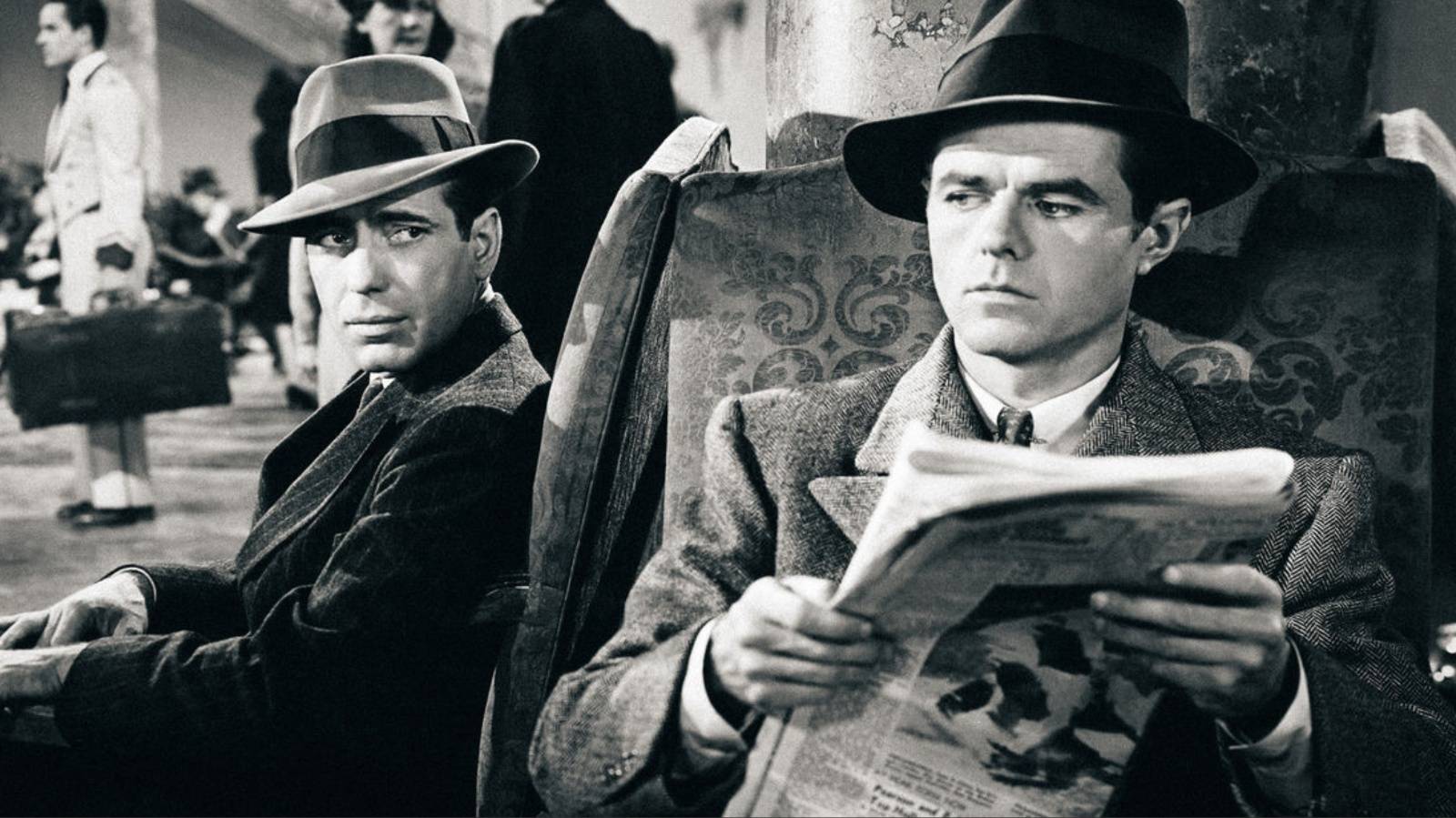
Film noir is one of the most distinctive movements in American cinema, defined by its shadowy cinematography and morally complicated characters. Its golden age, generally associated with the 1940s and ’50s, produced some of Hollywood’s defining film noirs, often centering around doomed heroes, hard-boiled private detectives, desperate grifters, or dangerously seductive femme fatales.
Of course, not every great film noir necessarily represents what makes the genre so distinctive. Take The Third Man, for example. Widely regarded as one of the greatest thrillers ever made, Carol Reed’s thriller is frequently associated with film noir, but its European setting, British production, and distinctive postwar atmosphere place it somewhat outside the traditional American noir cycle. Instead, this list will focus on 10 essential examples of the classic American movement, which unfortunately means setting aside European examples and later film noirs. Narrowing such an influential period down to 10 movies inevitably means leaving out some deserving classics, like In A Lonely Place, The Killers, or Sunset Boulevard, but this list serves as a starting point for anyone exploring film noir, representing the genre’s remarkable range and enduring appeal.
10
The Big Sleep

Howard Hawks’ The Big Sleep adapts Raymond Chandler’s novel of the same name, and it delivers one of the most entertaining film noirs ever made. Humphrey Bogart stars as Philip Marlowe, who’s hired by the wealthy General Sternwood to investigate a blackmail attempt against his young daughter. Before long, Marlowe is caught up in a web of murder, gambling, pornography, and blackmail, with everyone he meets hiding something. Marlowe has gone on to become one of the genre’s defining heroes, and as such, The Big Sleep is the perfect entry point for any film noir newcomer, with palpable chemistry, memorable moments, and a wonderfully cryptic tale.
Such a lot of guns around town and so few brains.
Most noirs skirted the extremely prohibitive production code in some way or another, but in The Big Sleep, it’s almost entirely related to just how risqué the dialogue is. Humphrey Bogart’s Philip Marlowe flirts with every woman he encounters; there are some extremely suggestive moments, and the sexual tension between Bogart and Bacall is palpable. The film is less a mystery to be solved than a wonderfully entertaining parade of shady characters and sharp dialogue. The Big Sleep is playful, and it proved that film noir isn’t always rain-soaked streets and criminal activity; it can be witty, stylish, and downright fun. That’s not to say the film has no edge — it’s filled with supremely dark, noirish moments, including the fate of poor Jonesy and the heart-racing climax.
9
Touch of Evil

Often described as the last great film of the classic noir era, Orson Welles’ Touch of Evil is a fitting farewell, despite its infamously fraught production history. Welles stars as Hank Quinlan, a bloated, corrupt, and openly xenophobic detective who has been planting evidence and taking bribes for so long that it has become second nature, and Welles’ incredible performance brings a kind of dignity and pathos to the character. When a bomb explodes on the American side of the Mexican border, killing an influential businessman, Quinlan finds himself investigating alongside Mexican prosecutor Miguel Vargas. The two men soon clash, particularly when Vargas suspects Quinlan of framing a suspect to secure a conviction.
He was some kind of man… what does it matter what you say about people.
Touch of Evil has perhaps the most iconic opening shot in cinema history, as one continuous take shows the journey of a ticking bomb placed in the back of a car, as it travels through a crowded border town. It’s a technical marvel, but it also establishes the film’s foreboding sense of dread before the story has even begun. Touch of Evil is certainly a product of its time, evidenced by the decision to cast Charles Heston as a Mexican character using makeup, but it remains a riveting and visually audacious film. It may be one of the great examples of noir’s obsession with corruption, yet Touch of Evil’s most compelling aspect is the moving relationship between Quinlan and his devoted partner Pete Menzies.
8
Out of the Past

Robert Mitchum’s hangdog expressions, imposing stature, and laconic delivery made him one of the great faces of film noir, and Out of the Past might be his finest noir performance. He plays Jeff Bailey, a former private eye whose attempt to start anew comes crashing down when a former associate tracks him down. The story is a well-worn noir premise: a man tries to escape his past, only to discover that the past has a nasty habit of catching up with him. It’s in The Killers, Dark Passage, and Act of Violence, to name a few. Bailey is hired by a wealthy, temperamental gambler to find his missing girlfriend Kathie, but as always, the job goes disastrously wrong.
Neither do I, baby, but if I have to, I’m going to die last.
What makes Out of the Past such a great example of the genre, aside from the stunning cinematography, is the sense of inevitability that accompanies every action Bailey takes. Mitchum plays the part with a hunched, weary manner that suggests he’s already made peace with his own destruction. He’s not an idiot, but he can’t resist the inexorable pull that Kathie has over him. Greer is incredible – she’s one of the coldest femme fatales of all noir, and her expression as Bailey fights with his partner is like a cat watching two mice, waiting for the opportunity to strike.
7
Scarlet Street

If any director can lay claim to the title of the godfather of film noir, then it’s Fritz Lang. M is one of the clearest progenitors of the genre, and he subsequently made several defining works, like The Woman In The Window and The Big Heat. Scarlet Street is the best, though. It’s a particularly nasty example of domestic noir, where there is no hard-boiled dialogue, no wisecracking private eyes, and no elaborate murder plots. Instead, it’s a story about an ordinary man whose loneliness makes him an easy mark.
Edward G. Robinson plays the desperately sad bank cashier, Chris Cross, who lives an unfulfilled existence with a wife who hates him, and whose only outlet is painting. When he comes to Kitty March’s rescue, he instantly becomes infatuated with her. Kitty isn’t interested, but along with her boyfriend Johnny, she recognizes Chris’ talent for painting, and they begin selling his art under her name.
When we’re young, we have dreams that never pan out, but we go on dreaming.
This is something of a reunion for the three actors, who previously appeared in The Woman In The Window together, and none of them were ever better onscreen. Bennett is utterly without redeeming features as the unscrupulous femme fatale, and Duryea makes for a loathsome heel, while still garnering sympathy in his final scenes. This is Robinson’s film, though, and he does a wonderful job portraying the incredibly sad man who wants to be loved so desperately that he can’t see how thoroughly he’s being used. Scarlet Steet’s ending is one of the most devastating of the entire genre, and Lang makes sure there’s no easy escape.
6
Kiss Me Deadly

For every The Maltese Falcon or The Big Sleep, there’s a Detour or a Born to Kill; noirs so sleazy and nasty, that it’s a wonder they got past the censors, particularly given how stringent the Production Code was at the time. Kiss Me Deadly might be the most outrageous of them all. Robert Aldrich’s film takes the familiar private-eye formula and turns it into something violent, disturbing, and downright apocalyptic.
Ralph Meeker plays Mike Hammer, just about the most brutal private eye there has ever been, as he finds himself caught up in a mystery involving a box, a procession of increasingly unsavory characters, and a far-reaching conspiracy. It’s unusual for the hero to be quite as nasty as Hammer, who inflicts pain on others with barely concealed pleasure. He’s a very different breed of hero to Sam Spade and Philip Marlowe, and he’s much more comfortable beating information out of people than doing detective work.
They? A wonderful word. And who are they? They’re the nameless ones who kill people for the great what-s-it. Does it exist? Who cares?
Kiss Me Deadly is bookended by two of the genre’s defining images: one of a woman clad only in a raincoat, panicking and waving down cars on a highway; the second of a woman opening a literal Pandora’s Box and unleashing hell. What makes Kiss Me Deadly so fascinating is the way it shows the darker side of noir and pushes the genre toward horror and science fiction. It’s a nasty, disorienting picture, but a wonderfully unique watch.
5
Night & The City

Some actors were just made for noir, and Richard Widmark might be the best of them. Widmark burst onto the scene as the sadistic villain in Kiss of Death, but he made a much more compelling noir protagonist. His performance in Night & The City as Harry Fabian is arguably his finest; the small-time hustler dreams of being a major player, and his latest scheme involves ingratiating himself with the local crime boss by persuading his father, a retired wrestling champion, to help organize a Greco-Roman wrestling club. Along the way, Fabian makes too many enemies, ends up with a bounty on his head, and nobody in London is willing to help him.
Fabian is both the hero and the villain of this story — he’s a crook and an opportunist, but there’s something strangely sympathetic about his refusal to accept that he’s been beaten. There’s a childlike naivety that accompanies his callous ambition that makes us like him, despite his many, many reprehensible actions. Night & The City is essentially the original Uncut Gems, as Harry desperately runs around London trying to raise money for the fight, and then, after everything goes wrong, he runs for his life. As one of his numerous enemies tells him: “You’ve got it all… but you’re a dead man, Harry Fabian.”
4
The Maltese Falcon

John Huston’s directorial debut wasn’t the first adaptation of Dashiell Hammett’s novel, but this is the one that everyone remembers. The Maltese Falcon is not necessarily the most visually adventurous noir, but it boasts a script that crackles with life, sharp dialogue, vivid characters, and a plot that moves at an astonishing pace.
Humphrey Bogart stars as private detective Sam Spade, who becomes embroiled in a search for the titular statuette after a mysterious woman hires him. Before long, Spade is surrounded by a collection of villains, all desperate to get their hands on the bird. There’s the jovial Casper Gutman, aka The Fat Man, the obsequious Joel Cairo, and the trigger-happy Wilmer Cook, as well as the enigmatic Brigid O’Shaughnessy. Huston keeps the convoluted story moving without ever losing sight of the details, and the result is a film that helped establish the language and beats of noir. The Maltese Falcon might not have the expressionistic visuals of some of the other films on this list, but its dialogue and performances are incredibly influential on other films in the genre.
3
Criss Cross

The Killers might be Robert Siodmak’s most famous film, but it’s his second film with Burt Lancaster that feels like the quintessential noir. From Criss Cross’s opening moments, there’s an overwhelming sense that its characters are heading toward disaster, and that no amount of scheming or wishful thinking will change their trajectory. Lancaster plays doomed protagonist Steve Thompson, a man who finds himself inexorably drawn back into the orbit of his ex-wife Anna, who is now married to the gangster Slim Dundee. When Steve becomes involved in an armored car heist, he becomes determined to escape with both Anna and the money, but fate has other ideas.
I never wanted the money – I just wanted you.
All three principal actors give some of their finest work in Criss Cross. Lancaster is more vulnerable and punchy than he was in The Killers; while Duryea makes for a silky-voiced, sadistic villain, and Yvonne DeCarlo is perhaps the most reluctant, misunderstood femme fatale of the era. As with the best noir films, the characters have the chance to get out of their situation and be happy, but their decision dooms them. The Killers might have the innovative story structure, but Criss Cross is the more definitive film noir in terms of mood. The whole film is drenched in foreboding, with characters who can’t help but run headlong into disaster.
2
The Asphalt Jungle

One of the most influential heist films of all time, The Asphalt Jungle might also be the best demonstration of the contradictions facing filmmakers under the production code. Protagonists had to be kind and compelling enough for audiences to like them, but the films also had to make it clear that crime doesn’t pay — usually by killing them off. John Huston’s Asphalt Jungle finds a fascinating compromise.
The story follows a gang, assembled by criminal mastermind Doc Riedenschneider to steal a fortune in diamonds. The team includes a tough but sentimental hoodlum, a loyal getaway driver, a safe-cracking family man, and their fence, a respectable attorney gone to seed. As with the best heist films, the robbery itself is meticulously planned, but the cracks start to show with the thieves themselves. Corruption, greed, and bad luck all converge to bring the entire police force down on the gang as they try to escape with the diamonds.
After all, what is crime, but a left-handed form of human endeavor?
Huston gives the criminals much more personality than the cops chasing them, with Hayden’s Dix Handley dreaming of returning to the Kentucky horse farm where he grew up, and determinedly racing to get there, even as he slowly dies of a gunshot wound. The Asphalt Jungle influenced pretty much every heist film that followed, from Rififi to Reservoir Dogs, but it’s more than a blueprint for a perfect heist film. It’s an object lesson that even the most carefully organized crime can fall apart when human beings get involved.
1
Double Indemnity

What you think of Billy Wilder will largely depend on which of his films you saw first. For many, he’ll always be the man behind heartfelt romantic comedies like The Apartment or raunchier fare like Some Like It Hot. For others, though, it’s his more cynical, black-as-pitch film noirs: the ultra-cynical Ace In The Hole, the Hollywood myth-destroying Sunset Boulevard, and best of all, the definitive film noir, Double Indemnity.
Fred MacMurray is perfectly cast as the likable heel Walter Neff, an insurance salesman who hatches a plan with femme fatale Phyllis Dietrichson to murder her husband and collect the insurance payout. It’s a foolproof plan, but Neff’s boss Barton Keyes is an unusually sharp claims investigator, and the pair soon find themselves desperately trying to keep one step ahead of him.
Yes, I killed him. I killed him for money and a woman. I didn’t get the money, and I didn’t get the woman. Pretty, isn’t it?
The script by Wilder and Raymond Chandler is a masterclass in genre storytelling. The framing device, as Neff confesses into a dictaphone, gives the film a feeling of impending doom from the outset, while the flashbacks gradually reveal how he got there. The dialogue itself is full of a kind of poetic film-logic that makes noir so distinctive. Neff’s description of silent footsteps as “the walk of a dead man” might sound absurd in another movie, but here, it’s perfect.
Stanwyck is the best femme fatale in all of noir, even when hampered by a ridiculous wig. There’s something genuinely chilling about the almost carnal expression on her face as Neff strangles her husband. Meanwhile, MacMurray is equally good as a man whose charm covers up the cynicism and venality just under the surface, while Robinson provides the film with its heart, as the loyal boss who is more disappointed in Neff than anything. The relationship between Neff and Keyes is unexpectedly touching. With superb performances, oppressive visuals, and razor-sharp dialogue, Double Indemnity doesn’t just tick all the boxes of film noir; it practically wrote the instruction manual.

- Release Date
-
July 3, 1944
- Runtime
-
107 Minutes
- Director
-
Billy Wilder
