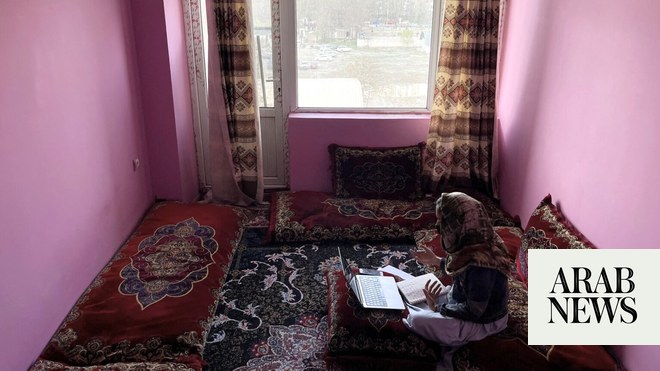
KABUL: Ahmadullah Faizi was happy when his 16-year-old daughter found a way to continue her education after the Taliban closed her school in Kabul three years ago.
She took online classes in graphics and design, and while virtual learning wasn't what Katie had planned for herself — she wanted to study computer science after graduating from high school — it provided some temporary relief.
“She is very creative … the online learning program helped her acquire new skills,” Faizi said.
“She is very happy and always helps everyone in the family to design work. She designs brand names and logos and works with various videos that she clicks from her phone.”
Faizi's daughter is one of nearly 1.1 million girls who have been denied access to formal education since September 2021 – a month after the Taliban took control of Afghanistan and suspended secondary schools for them.
Neither appeals at home nor international pressure have helped lift the ban, which Taliban officials have repeatedly said is an “internal matter”, as they later extended the ban to universities, preventing more than 100,000 female students from completing their degrees.
Islamic schools focused on the religious training of girls – public educational institutions licensed for madrassas – online classes have become the only available option to access modern education.
In a country where less than 20 percent of the population has access to the Internet, it is unclear how many girls and women are engaged in online education.
One of the main organizations offering online courses, the Afghan chapter of Women in Tech International – a global NGO that promotes and supports the achievements of women in technology – has registered thousands of users since launching its digital training program two years ago.
“Many of them have been able to expand their networks with experts from different countries and remote work opportunities, and some have started their advanced degrees online. These initiatives have provided them with valuable skills and a sense of empowerment and independence in a society where formal educational opportunities are restricted.” ,” Dr. Zahra Nazari, Country Director of Women in Tech told Arab News.
“We have trained more than 3,000 Afghan women through various programs including coding, AI, data science and digital literacy.”
Although such courses offer opportunity and hope – even if access to them is limited to those with devices and an Internet connection – there is no illusion that they can replace real schools and universities, or help women to become independent when there are restrictions on their work. .
“Short-term and online programs can only offer temporary and incomplete solutions,” said Faizi, whose daughter has learned design skills but has yet to put them into practice.
“Until schools and universities are reopened and women are provided with better job opportunities, the situation for girls and women will remain the same.”
Shabana Amiri, a 20-year-old from Kabul who will graduate from high school in 2021, has tried taking online classes and though she liked them, there was no way she could substitute formal education.
“In schools and universities we build careers and gain lifelong experiences while in short-term courses we learn only limited skills. The only solution is to open schools and universities,” she said.
“Otherwise, most girls want to leave the country for education. I don't want to live in Afghanistan and be illiterate for the rest of my life.
