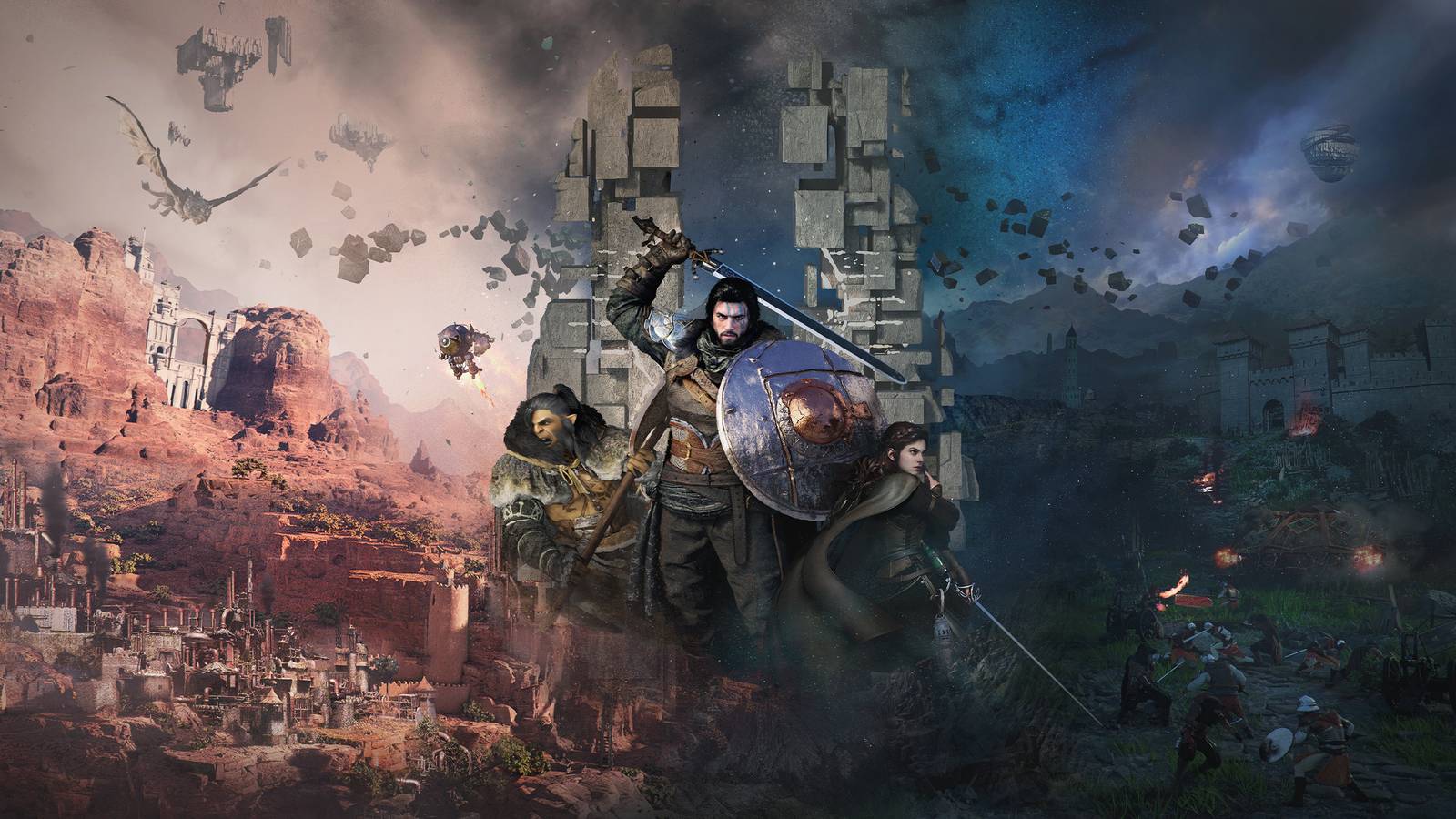
Within my first hour with Crimson Desert, I was riding a cow. Somehow, I had button mashed my way onto its back, and I couldn’t help but laugh at the sight of this bulky Greymane warrior trotting along atop cattle that was half his size. Around 30 hours later, I was only just beginning to figure out my way around the game’s countless systems—only just hitting my stride as light bulbs were finally appearing above my head and making the road ahead feel much smoother than it had before. If all of that doesn’t perfectly sum up my experience with Crimson Desert, I honestly don’t know what will.
Since its final marketing rollout began, Crimson Desert has been touted as something that is “too good to be true.” Even I, a stubborn optimist, had my doubts going in, but I was nonetheless continuously surprised by it, frequently with my jaw hanging open in disbelief. Crimson Desert has, without a doubt, what I would consider to be the absolute best open world design I have ever seen in a game—and that’s coming from a die-hard Zelda: Breath of the Wild fan. While there are plenty of quality-of-life issues, bugs, and strange design quirks that make the whole experience quite a bit less than the aforementioned “too good,” it is still all very real.
Crimson Desert’s World Is the Show Stealer—Its Story, a Side Gig
I will say up front that speculations have largely been on point about Crimson Desert, in that it really does feel like it has everything. You can fly jetpacks and dragons, you can use a wide variety of weapons like guns, bows, spears, and swords in combat, and you can grow crops, raise livestock, and furnish your home with items you either find or purchase on your journey. There’s a reputation system in the game similar to those found in games like World of Warcraft, where earning reputation with a faction can grant you access to unique gear, and you can build a relationship with Crimson Desert‘s merchants to eventually unlock new items for sale. You can capture outlaws for extra coin, complete side quests for townsfolk, hunt more unique wildlife than you can count for crafting and cooking materials, and even sell stolen animals to a fence.
Basically, a recurring theme in Crimson Desert is “If you think you can do it, you probably can,” and that’s ultimately due to the game’s highly interactive world. If nothing else, Crimson Desert‘s open world is its biggest selling point, not just because of how it looks, but because of how it feels. In fact, I can say with 100% confidence that this is the closest thing I’ve ever experienced to the real world inside a video game, with the way NPCs and the environment respond to your actions, and how the world genuinely does let you travel to whatever you see in the distance—assuming you have the stamina required to get there.
The sheer scope of it all is impressive, to say the least, especially considering how well Crimson Desert runs, even on older hardware. My high-end desktop PC naturally handled it well, but I even tried the game on my lower-end gaming laptop, and although the visuals were toned down quite a bit, it still looked incredible and ran like a dream. It’s not just the size of the world or the extensive draw distance I’m considering here either, but the world’s density as well. There are an endless number of NPCs wandering around, foliage everywhere that is constantly influenced by the wind and weather, abundant wildlife that will scatter at the sight of you, and innumerable buildings with interiors that are different enough that it rarely feels like you’ve visited the same place twice.
Basically, a recurring theme in Crimson Desert is “If you think you can do it, you probably can,” and that’s ultimately due to the game’s highly interactive world.
It feels like something of this caliber has never been done before—even though I would consider Crimson Desert to be a hodgepodge of Red Dead Redemption 2, Zelda: Tears of the Kingdom, Kingdom Come: Deliverance 2, and it feels, at times, pretty much any other game you can call to mind. It has taken the best elements of some of the best games out there and mashed them into one gigantic experience, and somehow, it still feels coherent in its presentation. This is one of those worlds that will keep its hooks in you, even after you’ve hit the 100-hour mark, because you can’t wait to get out there again and see what else you can find.

Crimson Desert‘s map (which I had my doubts about going in) takes a very minimalistic approach to ensure you’re rewarded for your curiosity rather than checking things off a to-do list. If you want something to show up on the map, you’ll need to find it first, and with how massive the world really is, that can often feel like finding a needle in a haystack. The upside, though, is that there are more than enough needles to find, so you’re constantly being rewarded for letting intrigue be your guide. Whether it’s happening upon a valuable Abyss Artifact needed for skill, stat, and gear progression, finding a cave with a puzzle to solve and a unique weapon behind it, or encountering a dynamic event where someone needs assistance, there is always something to do in Crimson Desert—and that’s still true after 120 hours in the game.
One of the most satisfying things to do in Crimson Desert is build up the Greymanes’ camp, as it can eventually become a one-stop shop for you, complete with merchants and ways to farm certain materials. In a way, it offers players a side activity that feels like something straight out of a cozy game like Stardew Valley. I’d say that even players with little combat skill can pour dozens of hours into it without too much of a headache. However, the quest line to get it fully fleshed out is extremely lengthy, and with so many of those quests requiring you to follow a slow-moving NPC to a distant location, it gets repetitive rather quickly.
Crimson Desert’s Open World Overshadows a Story That Struggles to Stick
It’s clear that Pearl Abyss wanted Crimson Desert‘s open world to be the star of the show, because not only do you need to spend plenty of time with it if you hope to make good progress in the story, but also the story itself really isn’t too much to write home about. For one thing, Kliff is a very one-dimensional protagonist, despite having a tough exterior and a soft heart. There is almost no character development for him throughout the game, and although Alec Newman’s vocal performance is excellent, Kliff’s personality and character arc are so flat, Newman hardly had a chance to truly shine.
Crimson Desert‘s narrative is also very hard to follow, both on account of its obscurity and the fact that you’re likely to spend so many hours exploring the game’s open world and seeing its endless number of side stories unfold that you’ve forgotten what was happening in the campaign by the time you resume it. Some of the best stories actually occur in the Greymanes quest line, as the interactions between Kliff and his companions can really make you feel like you have a family in Pywel. Apart from that, I’d say the main narrative serves as context more than anything else, even when that context isn’t necessarily clear.
Crimson Desert’s Limitless World Is Surprisingly Limiting Beneath the Surface
After spending over 120 hours with Crimson Desert, I’ve come to the conclusion that the game considers slowing you down at every turn to be its full-time job. I spent many of those hours completely stumped by puzzles, hitting a wall in some incredibly difficult boss fights, repeatedly watching the same cutscenes that could be sped up but never skipped, and grinding for Abyss Artifacts just so I could get incrementally stronger. Even the dragon, one of the biggest talking points of Crimson Desert ahead of its launch, can only be used for around 10 minutes before its hour-long cooldown begins, and you’re forced to wait before using it again.
It’s not that things aren’t easy enough or even that they should be, as genuine difficulty is both manageable and subjective. And it’s not that they are too complex either, as even complexity has its workarounds. It’s that, for how massive and wide-open its world is, how liberating it presents itself, Crimson Desert is ironically chock-full of invisible barriers—not caused by bugs, but by the game’s design. There are considerable inventory limitations in an otherwise loot-heavy open-world game, crafting requirements that strongly discourage experimentation, pacing issues caused by the game’s preference for itself over players, a general lack of opacity in many of its systems, and a progression philosophy rooted far too deep in the community collaborating to find solutions to in-game roadblocks.

I eventually came to terms with the fact that I had no choice but to play Crimson Desert at its pace rather than my own, and when I did, I found the game much easier to play and enjoy. However, I wouldn’t necessarily consider that to be a positive in this case. It’s one thing for a game to demand patience from its players, but it’s another for it to feel like that patience is constantly being tested by systems that resist the player instead of working with them. Crimson Desert has all the pieces of something truly special, yet it often feels more concerned with controlling how and when players engage with those pieces than simply letting them do so. The result is an experience that can be exceedingly rewarding once it finally clicks, but one that asks for far more adjustment from the player than it reasonably should.
Crimson Desert Leaves Players Guessing More Than It Guides Them
A lot of this comes from how unclear and inconsistent Crimson Desert‘s systems can be. Some quests ask players to perform oddly specific actions with little or no guidance, to the point where it’s hard to tell whether something is designed that way or simply not working as intended. Several quests in the game give players dialogue choices that don’t really matter, as picking the “wrong” choice just loops the same conversation until the correct response is selected. And speaking of dialogue, while there is plenty of variety in the game’s voice lines, there were plenty of characters that would repeat the same line or noise over and over again. Turning in bounties, for instance, triggers the same cutscene every time, even if it’s in an entirely different location and involves a different NPC.
Even basic interactions like picking up items can feel unreliable after dozens of hours, and the control scheme doesn’t always cooperate, with overlapping inputs frequently leading to unintended actions. That same lack of clarity affects traversal and exploration as well, where parkour often slows movement due to environmental snags that arguably should have been negligible, and cities lack internal fast-travel points, forcing players to repeatedly cover unnecessary ground just to reach key locations.
Crimson Desert has all the pieces of something truly special, yet it often feels more concerned with controlling how and when players engage with those pieces than simply letting them do so.
Crimson Desert‘s Zelda-like puzzles also create some significant pacing issues, simply because their solutions are often so obscure that solving them can still leave you feeling like you’ve wasted precious time in the game. There were plenty of moments throughout my journey in the game where solutions were as “simple” as leaning against a wall for a second longer than I initially tried or as unclear as stabbing a pedestal with my sword in order to rotate it—even though the handles were right there on the ground and I theoretically could have picked them up and used my Spirit abilities to lodge them back in. Moments like these were exhausting, but I eventually learned my lesson and stepped away from a puzzle if I couldn’t solve it within 10 minutes or so.
Crimson Desert Turns Difficulty Into a Battle Against Its Own Systems
Combat and progression have their own set of problems, many of which feel less like intentional difficulty and more like friction for its own sake. Boss fights can swing wildly between being manageable and overwhelming, with the more challenging encounters seeming to rely more on how many healing items you have or whether you’re able to control the stubborn camera than your ability to master mechanics. Also, if you fail or give up on a boss encounter that occurs right after a cutscene, when you return, you’ll have to watch the entire cutscene again. Thankfully, Crimson Desert lets you fast-forward those scenes, but I fail to understand why there isn’t an option to skip them altogether—at least after they’ve been viewed once.

I have a feeling Crimson Desert‘s boss fights might be the one thing that turns the game’s more casual audience away, because it takes an unorthodox approach to difficulty. Whereas most games (apart from, perhaps, games by FromSoftware) save the easier boss encounters for the story and make the more challenging fights optional, the majority of Crimson Desert‘s mandatory story bosses are just as hard, if not more so. In essence, it’s really not possible to mainline the story here like you might be able to in your run-of-the-mill action-adventure game, because the frequent difficulty spikes require hours of grinding on the side.
Large-scale battles have similar issues, with AI allies often standing around doing nothing while enemies proceed to attack you, and environmental hazards like explosive barrels that are far too difficult to see in all the chaos until it’s too late, and you’ve been blasted across the screen to your demise. Many of these battles also have ludicrous completion requirements. Not because of the challenge they pose, but because, again, it feels as though Crimson Desert wants to slow you down. Conquering an enemy camp or region generally sees you thrust into a Musou-like encounter, where you’re required to defeat hundreds of enemies to progress. It’s fun at first, but in the end, it’s repetitive enough that it feels like Crimson Desert wants to add more hours to its gameplay rather than give players an engaging encounter they’ll remember.
Combat in general is somewhat exploitable, but still enjoyable. The animations are great, and landing hits feels satisfying in the moment. However, certain skill paths quickly prove more effective than others, which can lead to repetitive playstyles. With my build, I eventually found a powerful two-handed sword and paired it with abilities that let me spam heavy attacks and dodge when needed. From there, I had little reason to experiment, as that loop was consistently more reliable than anything else I tried.
I have a feeling Crimson Desert‘s boss fights might be the one thing that turns the game’s more casual audience away, because it takes an unorthodox approach to difficulty.
Progression systems in Crimson Desert don’t fare much better, as Abyss Artifacts are required for both skill unlocks and higher-tier gear upgrades, making every use of one feel risky and ultimately limiting experimentation. Abyss Artifacts can be acquired in several different ways, from defeating enemies or finding them in the wild to receiving them as quest rewards or completing weapon and exploration-based requirements to unlock them. But even with so many ways to obtain them, later skill and stat unlocks require more than a handful of them, so using just one on a tier 5+ gear upgrade can be painful. I rarely upgraded my gear past tier 4, because I never knew when I might find something better or whether I wanted to save my Abyss Artifacts for skill and stat improvements.
That disappointment is only compounded by the fact that there are countless weapons, gear pieces, and gear sets to find in Crimson Desert. The main issue is that some of the game’s boss battles all but force you to upgrade your equipment if you want to have any chance of surviving, and yet doing so means you’re potentially going to use the game’s most valuable resource in the process. Then, assuming you find something better (which you will), you’ll replace that gear you just spent an Abyss Artifact on with something else, effectively wasting an item that could have been put toward a stat upgrade or skill unlock instead.
A transmog system for Crimson Desert would probably help alleviate this issue a bit, as it would give players more incentive to purchase or hold onto gear and simultaneously relieve any pressure to upgrade it in order to justify wearing it in place of something that is already better.
That bottleneck also discourages using Crimson Desert‘s other playable characters, Damiane and Oongka, as their progression is entirely separate from Kliff’s, apart from stat upgrades. It is nice that any Abyss Artifacts spent on the game’s core stats of Health, Stamina, and Spirit—as well as certain movement and Spirit-based skills—are shared between characters, but almost everything else isn’t. It makes sense for each character’s gear to receive separate upgrades. Still, since those higher upgrades require Abyss Artifacts, they don’t feel worth it, especially since Kliff is required for the majority of the story content and has better skills anyway.

It’s even worse when Crimson Desert forces you to play as Damiane or Oongka, which, to be fair, only happens a couple of times. Still, it can feel like starting over due to the lack of shared progression between characters, as those specific moments give you no choice but to defeat a challenging boss with that character. It’s already difficult needing to learn an entirely new playstyle, but their weaker gear and skill trees that are only about a third the size of Kliff’s can also make those encounters feel like impassable brick walls.
The thing about most of these issues (not all), is that they can be fixed or at least improved with some quality-of-life updates. Pearl Abyss has already committed to adding player storage after there were complaints about inventory limitations, so that’s a good sign moving forward. However, there’s no way of knowing whether the developer will commit to resolving the game’s other quality-of-life issues, or whether it sees them as issues in the first place.

After all the time I spent in Crimson Desert, I clearly have a lot of complaints about its design, but it’s hard to say it’s not worth playing—because it absolutely is. I kept finding myself coming back to it, if only to see what might surprise me next or what I might finally understand on a second attempt, and I know that’s largely because its highly interactive open world carries the whole experience. As long as you view it through that lens, it’s excellent. I just can’t pretend that these issues don’t exist just because Crimson Desert‘s world does a lot of the heavy lifting.
Crimson Desert will likely appeal most to players who enjoy getting lost in an incredibly detailed and realistic open world and figuring things out for themselves, even when the game isn’t always clear about how everything works. Those who value exploration and long-form progression will find plenty to dig into, especially if they don’t mind learning it all through a fair amount of trial and error. On the other hand, players who prefer a more streamlined experience, a stronger narrative focus, or systems that clearly communicate their rules may find the journey more frustrating than rewarding. Even though Crimson Desert initially seemed like a game for everyone, it’s not, but it is one that everyone should at least try.

- Released
-
March 19, 2026
- ESRB
-
Mature 17+ / Blood, Drug Reference, Intense Violence, Strong Language
- Developer(s)
-
Pearl Abyss
- Publisher(s)
-
Pearl Abyss
- Best-in-class, highly interactive open-world design
- Strong sense of discovery and exploration
- Massive content with long-term engagement
- Visually impressive with solid performance
- Satisfying combat feel and animations
- Systems lack clarity and guidance
- Progression limits experimentation and builds
- Boss fights feel inconsistent and chaotic
Crimson Desert is coming to PC, PS5, and Xbox Series X|S on March 19, 2026. GameRant was provided with a PC game code for the purposes of this review.
