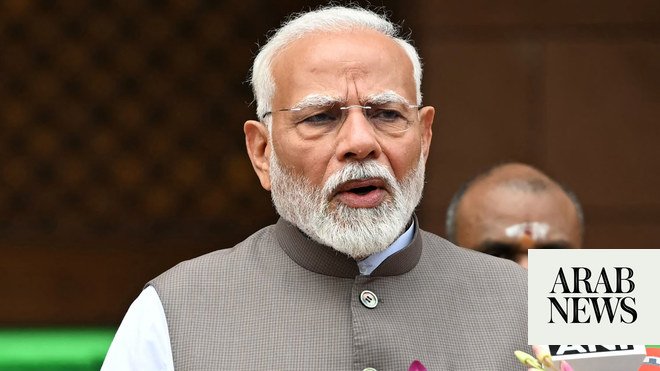
New Delhi: Indian Prime Minister Narendra Modi's first post-election budget on Tuesday will seek to lay out an economic vision that balances fiscal prudence with the expectations of disaffected voters and the demands of his coalition partners.
“This budget will determine the direction of our work for the next five years and it will lay the foundation for achieving our goal of making India a developed country by 2047,” Modi said before the budget to be presented to the Finance Ministry on Monday. Minister Nirmala Sitharaman.
Modi's Hindu nationalist Bharatiya Janata Party (BJP) failed to win a majority in last month's election, and has become dependent on allies to form a government for the first time since he came to power more than a decade ago.
The budget is expected to cut taxes for the middle class, provide relief for troubled rural areas and heed the demands of two key alliance partners – the Telugu Desam Party of Andhra Pradesh and the Janata Dal (United) of Bihar. areas.
“Weak political capital, an uneven growth story with light consumption, and lost vigor in private capital and the rural sector form the backdrop for the upcoming budget,” said Madhavi Arora, economist at MK.
The government will also seek to keep at bay a resurgent opposition that criticizes the Modi government for lack of jobs, high cost of living and rising income inequality.
According to a report by the World Inequality Lab, the concentration of wealth in India's richest 1 percent of the population is the highest it has been in six decades, while youth unemployment is over 17 percent, according to government estimates.
infrastructure spending
A government report published on Monday projected economic growth of between 6.5 percent and 7 percent for the current fiscal year, slightly below consensus analysts' estimates.
However, the government has enough cover from the central bank to ensure it is able to bridge the budget gap and finance infrastructure projects.
In May, the Reserve Bank of India transferred $25 billion in surpluses to the government to help it cover demands from coalition partners for tax cuts, help for rural areas and regional funding.
Over the past three years, the government has nearly doubled spending on long-term infrastructure projects as a means to spur growth and create jobs, and plans to spend 11 trillion rupees ($131.51 billion) on such projects this year.
Some economists expect the budget to reform incentive schemes for domestic and foreign companies to boost production in 14 sectors, including electronics, semiconductors and pharmaceuticals in India.
On Monday, the government's economic survey warned of rising risks from surging equity markets, which are luring retail investors into risky derivatives trading.
To discourage such risky investments, economists say the budget may include measures such as raising capital gains tax on long-term equity investments. However, according to Morgan Stanley, such a move could be a major dampener for Indian equities and impact the stock market.
Any increase in the transaction tax on derivatives would also be a negative surprise, Jefferies said.
Finance Minister Sitharaman is scheduled to present the budget from 0530 GMT.
