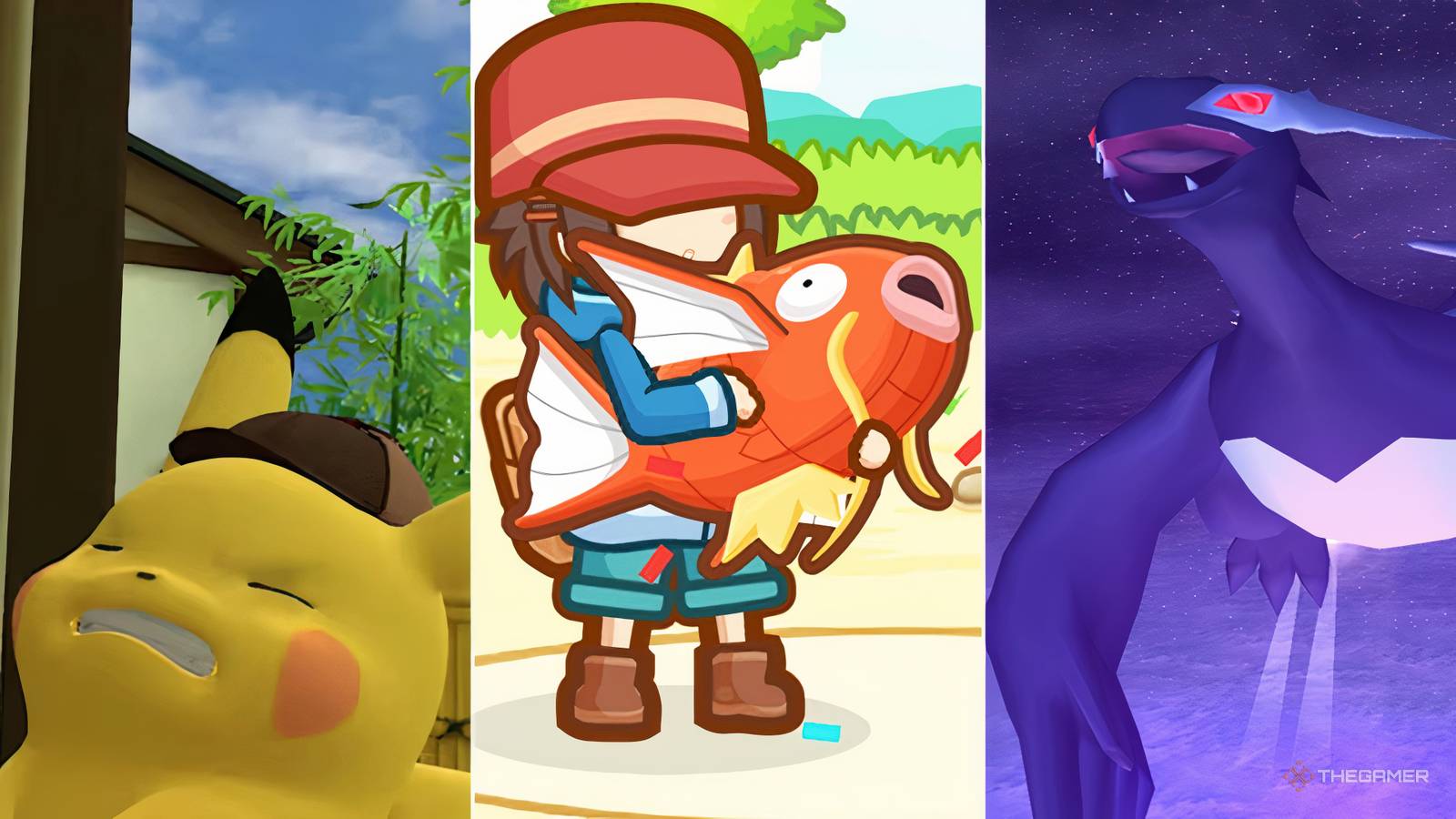
With over 1,000 creatures in the franchise, only a select few Pokémon are considered popular, iconic, or unique enough to carry their own spin-off game. While most spin-offs feature a full roster for players to enjoy, some titles single out a specific Pokémon and build the entire experience around them, whether that means solving crimes, building an island paradise, or just taking a nap.
From beloved mascots to unlikely heroes, these are the Pokémon that have come out of the tall grass and into the spotlight with games specifically built around their unique appeal.
8
Snorlax – Pokemon Sleep

Only Snorlax can headline a game where the primary mechanic is sleeping. Released in 2023, the mobile app Pokemon Sleep puts the famous sleepy Pokemon front and center as the game's mascot and core gameplay driver. Players track their real-world sleep using their phones, and each morning they wake up to find different Pokémon that gather around Snorlax during the night. By feeding Snorlax berries and cooked food, players increase its sleep power, which attracts rare Pokemon and new sleep styles to the list.

All the differences between Pokemon FireRed and Leaf Green and the Red and Blue versions
A lot has changed between Generations One and Three, so Pokémon FireRed and LeafGreen are the Pokémon Company's attempts to catch Kanto up to speed.
It's a great on-brand role for a Pokemon whose entire identity revolves around eating and sleeping. Snorlax's strength grows as the player maintains healthy sleep habits, creating a unique healthy feedback loop – take good care of yourself, and Snorlax will thrive too. While it's more of a wellness app than a traditional game, Pokemon Sleep gave Snorlax a key role that no other Pokemon could naturally fill.
7
Magikarp – Magikarp jump

Magikarp has spent decades as the franchise's most beloved punchline – the useless fish that flops around and does nothing until it suddenly evolves into the terrifying Gyarados. So it was only a matter of time before someone made an entire game around that joke. Released on mobile in 2017, Magikarp Jump tasks players with raising generations of Magikarp and training them to jump as high as possible in league competitions.
What makes Magikarp Jump so special is how utterly silly it leans. You feed your Magikarp, train it with a little practice, and enter jumping competitions against rival Magikarp. Between leagues, random events can befall your fish—some useful, others hilariously tragic, like Pidgeotto swooping down and taking your precious MagiCorp away forever. It's a simple idle game, but its charm lies in turning the franchise's most miserable Pokémon into unlikely champions. The game proved that you don't need a legend on the box to make a compelling spin-off – sometimes, you just need a fish with a dream.
6
Mewtwo – Pokken Tournament

Mewtwo has always been one of the franchise's most influential figures, so casting it as the central antagonist of a full-fledged fighting game was a natural fit. Pokémon Tournament brought Pokémon battles to the arena fighting genre. While the roster features a wide array of fighters, the story mode revolves around the mysterious Shadow Mewtwo – a corrupted version of the genetic Pokémon wielding a strange dark synergy stone.
Shadow Mewtwo serves as the final boss and story linchpin of the single-player campaign, with players working to uncover the source of its corruption and ultimately free it. It's a role that plays on the established lore of Mewtwo as a powerful, tortured creature wrestling with forces beyond its control. Pokken Tournament proved that Pokémon could work in the competitive fighting game space, and Mewtwo's presence as the big bad gave the game a narrative weight that it might have otherwise lacked.
5
Espeon and Umbreon – Pokemon Colosseum

Pokemon Colosseum was a radical departure from the main series when it launched on the GameCube in 2003. Instead of a bright-eyed kid setting off on a journey through the tall grass, players take on the role of Wes, a former member of a criminal organization in the desert region of Orre. And instead of choosing from the usual trio of starters, Weiss starts the game with two fully-evolved Eeveelutions: Espeon and Umbreon.
It was a bold choice that set the tone for the entire game. Espeon and Umbreon weren't just your first Pokemon—they were partners in a scarier, more morally complex story than the series had ever told. There were no wild Pokemon encounters in the Colosseum; Instead, players had to 'snag' Shadow Pokemon from other trainers and work to purify them. Having Espeon and Umbreon as the constant anchors of your team in this dark story gave them an importance that starter Pokemon rarely achieve. They weren't just tools for war—they were Wes' companions in a true redemption story.
4
Eevee – Pokemon: Let's go, Eevee!

Eevee has always been one of the franchise's most popular Pokemon, thanks to its unique ability to evolve into many different forms, but Pokemon: Come on, Eevee! gave it something it never had before – top billing as a version mascot on a par with Pikachu. Released alongside Let's Go, Pikachu! In 2018, the game reimagined the Kanto region with a companion Eevee that rides on the player's head, cannot evolve, and learns special moves that no regular Eevee can use.
What made this version special was how it reintroduced Eevee as a Pokémon worth celebrating in its own right, rather than as a stepping stone for one of its many evolutions. Your partner Eevee is expressive, lovable, and powerful, covering many types with special moves that shake up its evolutionary potential without needing to transform. It was also a savvy bit of franchise management – Eevee has steadily grown in popularity over the years, and giving it its own version of the mainline-complete game cemented its position as the franchise's second mascot.
Eevee also appears as a starter Pokemon in Pokemon XD: Gale of Darkness and Pokemon Conquest, making it the most frequently spotlighted Pokemon in spin-off history.
3
Lugia – Pokemon XD: Storm of Darkness

Pokemon XD: Gale of Darkness on the GameCube is remembered for many things – its unique Shadow Pokemon mechanics, its setting in the arid Ore region, and its status as one of the most underrated games in the franchise. But its most notable feature is Shadow Lugia, known in-game as XD001, a corrupted version of the legendary Pokemon that serves as the game's central antagonist and ultimate prize.
The Shadow Lugia is visually unremarkable, with a dark, armored redesign that makes it look genuinely menacing compared to its usual calm appearance. The entire plot revolves around the villainous organization Cipher's attempt to create the ultimate Shadow Pokemon – one whose heart is so completely sealed that it can never be purified. Players spend the entire game working out the moment they can encounter and capture a Shadow Lugia, then begin the painstaking process of opening its heart. It's one of the most memorable story arcs in any Pokemon game, and it gave Lugia a dramatic role that went far beyond being a box legend.
2
Ditto – Pokemon Pokopia

Pokemon Pocopia, the life simulation spin-off of the series, features none other than Ditto – the blobby, shape-shifting Pokemon most players recognize as a reproductive tool. In Pokopia, a Ditto transforms himself into a human and sets about cultivating a desolate landscape into a paradise inhabited by Pokémon.
It's an inspired choice of hero. Ditto's signature ability to transform gives the game a natural narrative hook, and the idea of Pokemon mimicking humans to build worlds for other Pokemon is both appealing and a little surreal. Co-developed by Game Freak and Omega Force (of Dragon Quest Builders fame), Pokopia has received mostly positive reviews and, at the time of writing, currently holds the distinction of being the highest-rated Pokémon game on Metacritic. After years of being overlooked in favor of flashier creatures, Ditto is finally getting the spotlight it deserves—and it turns out this little blob has been hiding a masterpiece the whole time.
1
Pikachu – Spy Pikachu, Hey You Pikachu, and more

No Pokémon has starred in more spin-offs than the franchise's electric mascot, and it's not even close. Pikachu's spin off resume is amazing. Hey you, Pikachu! The N64 had a Virtual Pet game that let players talk to Pikachu via a microphone peripheral – a wild experiment for the time. The Pokemon Channel on the GameCube served as its spiritual successor, casting Pikachu as your companion while you watched in-game TV shows. Pokemon Dash on the DS was a racing game starring a little yellow mouse. And then there's the Detective Pikachu series, which reimagined Pikachu as a gruff, coffee-swilling private investigator who solves mysteries with a human partner — a premise so unique and so perfect that it spawned a blockbuster live-action film starring Ryan Reynolds.
What's remarkable about Pikachu's spin-off career is the sheer variety. It has been a virtual pet, a spy, a racer, and the main partner in Pokemon: Let's go, Pikachu! Each game finds a completely different angle on the character, proving that Pikachu's appeal is versatile enough to carry just about anything. While other Pokemon on this list have gotten a shot at the spotlight, Pikachu has been given the keys to the franchise time and time again — and has delivered every time.

Pokemon TCG: The Best Full Art Cards, Ranked by Artwork
With full art Pokemon cards, you have to stop and admire the work – and these are the best.
