The Star Trek franchise has been alive for 60 years and counting, which means it has had plenty of time to fill in any plot holes and answer any dangling questions. Star Trek has solved many mysteries over the years, from Enterprise finally explaining why the Klingons lacked their forehead ridges in The Original Series to Strange New Worlds confirming the old fan theory that Trelane has been a Q all along.
On the other hand, it’s not the duty of each new Trek series to simply settle unfinished business, so a number of mysteries are yet to be solved. Some might involve lingering questions from episodes that never got a sequel, or plot threads that ended abruptly when a show was canceled. Others concern characters who just upped and vanished from the franchise and were never seen again. Fingers crossed the following seven mysteries will finally be resolved by the time Star Trek reaches its 120th anniversary.
7
Who Was Future Guy In Star Trek: Enterprise?

Enterprise played with its nature as a prequel from the off. As featured in the show’s debut season, the Temporal Cold War arc established that various factions were attempting to alter the Star Trek timeline. The big brain moving all the pieces around the quantum chess board was a mysterious individual with the nickname ‘Future Guy’. He offered cryptic advice to either the Suliban or Captain Archer, depending on what best aided his enigmatic aims at the time.
Despite appearing as early as Enterprise‘s pilot episode, “Broken Bow,” the show never revealed Future Guy’s true identity, as he was only ever depicted as a shadowy hologram in a high-collared uniform (like Star Wars’ Emperor Palpatine only with better tailoring). Obviously, the writers planned to fully explain who Future Guy was eventually, but this aborted story arc was one of the many frustrations caused by Enterprise‘s cancellation after just four seasons.
Thankfully, we at least know what the creative team’s intentions were for this character. Enterprise co-creator Brannon Braga has confirmed in the years since that Future Guy was an older version of Jonathan Archer, who hails from a dystopian timeline and is working to manipulate his younger self and his enemies to correct history. Those who like this explanation can consider this canon, but those who don’t can ignore it and keep coming up with their own theories.
6
Why Did Saavik Leave the Crew In Star Trek IV?

After her introduction in The Wrath of Khan, the half-Vulcan, half-Romulan Saavik became a much-loved part of the Enterprise crew, even with Robin Curtis replacing original actor Kirstie Alley for The Search for Spock and The Voyage Home. Sadly, Star Trek IV proved to be her final appearance in the franchise to date; Saavik only features in the very beginning of the film before Kirk and company leave her behind on Vulcan.
On screen, there is no given explanation for why Saavik has to part ways with the crew, leaving her complete absence from the franchise’s future a frustrating open-end. The writers had planned a shocking explanation for Saavik’s absence: she was pregnant with Spock’s child, following the younger, resurrected Spock going through Pon farr in Star Trek III. Leonard Nimoy objected to the idea of Spock becoming a father, however, and so the writers hastily removed the explanation from the script.
Decades later, Curtis performed the cut scene on a podcast, which allowed fans a glimpse at how Saavik’s original exit from the franchise was going to look. In the finished film, Saavik may disappear without any fanfare, but the deleted dialog would have had huge repercussions for both Spock’s character and Trek canon if it made it into the movie.
5
What Did Sela, Thomas Riker, and Scotty Do Next?
The Next Generation’s episodic nature means many characters simply disappear from the show. To list them all would be too enormous an undertaking, but three of the most notable examples are Tasha Yar’s Romulan daughter Sela, Riker’s transporter clone Thomas, and the great Montgomery “Scotty” Scott.
After Seasons 5 and 6 set her up as a major antagonist, Sela quietly vanishes from TNG, despite her character’s enormous potential for a redemption arc. Thomas Riker, meanwhile, at least got himself a guest spot on Deep Space Nine, but his heel turn as a surprise Marquis double agent only raises more questions than it answers, and fans never saw him again. Scotty, meanwhile, made his last Trek appearance in Season 6’s “Relics,” which brings him into the late 24th century and then reveals nothing about what this franchise icon does next.
Those determined to find out what happened to these characters can do so by hunting down their appearances in semi-canon sources. For instance, Star Trek Online reveals Sela became the ruler of the Romulan Empire after Romulus’ destruction in the 2009 film. However, when it comes to live-action Trek, these three characters — and many more besides — were unfairly let down by TNG and its sister series.
4
What Was the Aftermath of the Dominion War?

The biggest mystery concerning the end of Deep Space Nine used to be “Did Sisko ever return home?” but Starfleet Academy Season 1 finally provided an answer to that one — and unfortunately, the answer was a big fat no. There’s still something else that fans have been wondering about ever since 1997, however, and that’s exactly what happened in the aftermath of the Dominion War.
With TNG over and Voyager taking place in the Delta Quadrant, DS9 was free to put the Federation through the wringer in its later seasons as Benjamin Sisko led Starfleet in an all-encompassing war against the Dominion, a Founders-led network of species. The Dominion War rewrote the Alpha Quadrant’s political landscape and appeared to be fought against an insurmountable threat.
Even with the war’s end in DS9‘s series finale, fans expected further skirmishes with a threat as vast as the Dominion, but that never happened. Picard did introduce the Changeling villain Vadic, the leader of a sect of Founders still bitter over the Dominion War, but she was merely a lone radical. Yet would Vadic really be the only one still holding a grudge against the Federation? Were the Jem’Hadar really happy to stop fighting, or the power-hungry Vorta content to retreat?
3
Are Discovery And Strange New Worlds Set In a Different Timeline?

Both Discovery and its spinoff, Strange New Worlds, are ostensibly prequels to The Original Series, but they differ from the classic show in everything from technology to characterization. As they share more of an aesthetic and tone with the Kelvin timeline movies than TOS, fans have often theorized that they actually exist in their own universe, despite the official party line stating they’re set in the prime timeline.
And yet Star Trek itself suggests this isn’t the case. In Lower Decks‘ series finale, a Klingon was exposed to a temporal anomaly that causes multiversal shifts and briefly transforms into one of Discovery‘s very different Klingons, suggesting the show takes place in an alternate universe. Similarly, Strange New Worlds Season 2 episode, “Tomorrow and Tomorrow and Tomorrow,” confirms that Khan’s uprising no longer canonically takes place in the 1990s due to Romulan interference with Earth’s history. Given that 2009’s Star Trek told fans more about how a new universe is created, this would appear to confirm Discovery and Strange New Worlds occupy their own altered timeline.
From a marketing perspective, it makes sense for the showrunners to promote Discovery and Strange New Worlds with connections to The Original Series, but when you stack up all the evidence, it does appear that the Discovery corner of Trek takes place in a third universe separate from both the prime and Kelvin timelines.
2
What Happened to the Parasite Takeover of Starfleet?

The Next Generation ditched various aspects of its shaky first season as it moved forward, including the crew’s clingy original uniforms, Picard’s ultra-uptight characterization, and various plot threads. While the franchise revisited many of these — like Beverly Crusher’s return or Tasha Yar’s death — the franchise hasn’t bothered to acknowledge a major cliffhanger from TNG Season 1.
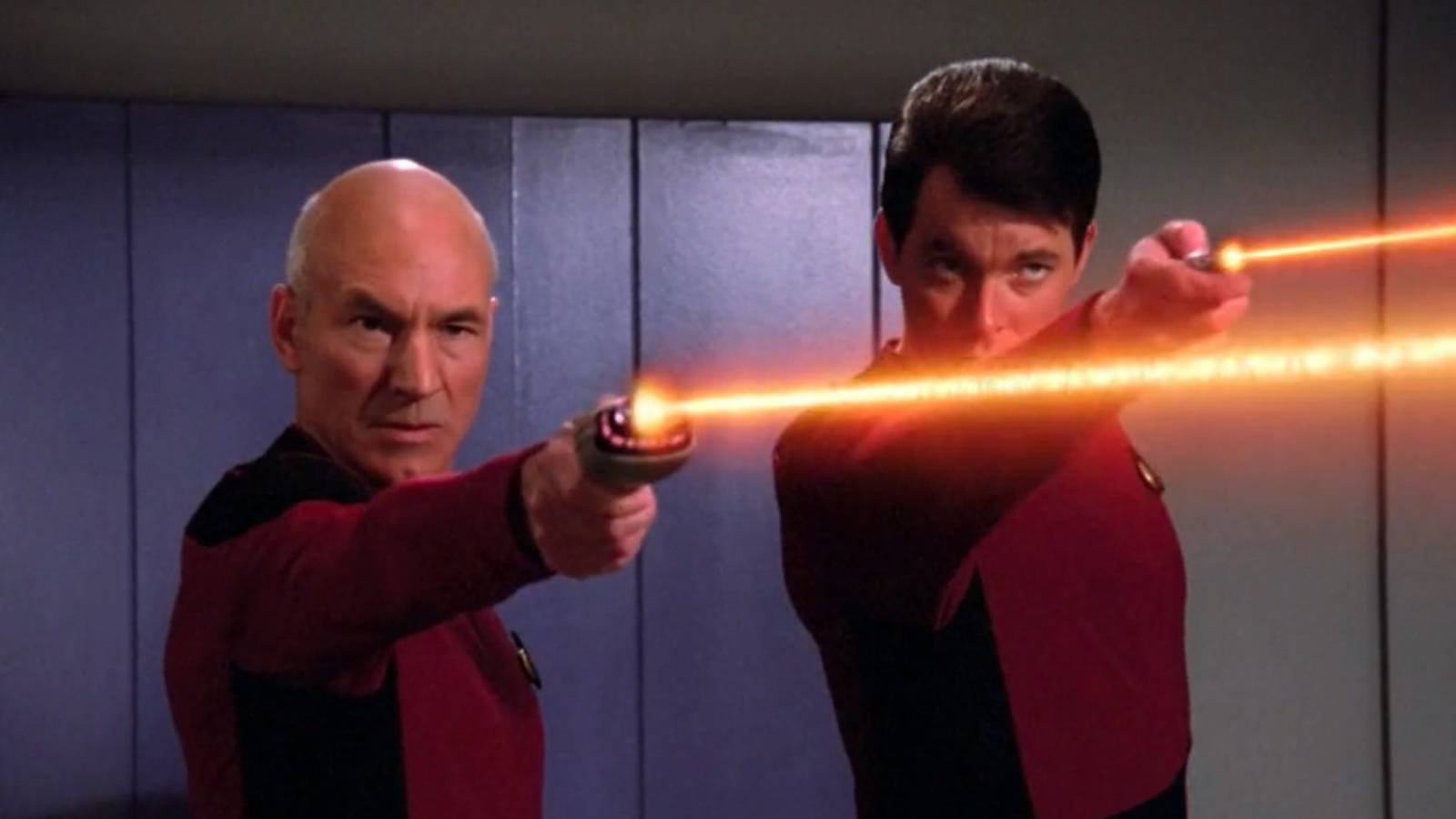
In the season’s penultimate episode, “Conspiracy,” the Enterprise-D crew discover that a race of mind-controlling insectoid parasites have taken over a group of Starfleet officers and are attempting to take over the Federation. By the episode’s end, Picard and Riker have offed their leader, Lieutenant Commander Remmick (by using their phasers to blow up his head). However, before he died, Remmick managed to send out a beacon to the other parasites, signaling it was time to invade Earth.
As per initial plans, the parasites would’ve been TNG‘s main villains, but this was abandoned once the Borg debuted in Season 2 and instantly became a big hit.
However, TNG never brings this up again, and fans can only assume that the parasite invasion wasn’t as sinister as it sounded and was simply dealt with off-screen. Although, considering the shapeshifting Changelings infiltrate Starfleet in DS9, this seems hard to believe. Maybe the parasites secretly took over Starfleet all along, and nobody ever realized. That would explain all the bad admirals.
1
Does Warp Travel Still Have a Damaging Effect on Space?

As egregious as TNG‘s many other mysteries are, the most notorious surely has to be the revelation in Season 7’s “Force of Nature,” which sees the Enterprise crew discover that cumulative warp travel is having a harmful effect on the fabric of space. The constant use of warp travel punches holes in subspace, which will eventually have catastrophic consequences. As such, Starfleet ships are forbidden from traveling at more than Warp 5 outside of emergencies.
Aside from a couple of brief references in later Season 7 episodes, the franchise hasn’t brought this warp speed limit up again. Discovery and Starfleet Academy have confirmed that warp drives remain the primary means of space travel for the Federation into the 32nd century, which implies that Starfleet has been shredding subspace for almost 1000 years. That’s despite promising alternatives being developed, like the Discovery’s spore drive.
Fans have speculated that Starfleet simply upgraded their ships so that warp travel no longer had such a harmful effect, but this is just a theory, as nothing in the past 30 years of Trek indicates this has occurred. “Forces of Nature” was intended as an allegory for climate change, so maybe it is only true to life that the Federation became aware of what they were doing to the environment and carried on regardless.
- First Film
-
Star Trek: The Motion Picture
- First TV Show
-
Star Trek: The Original Series
- Created by
-
Gene Roddenberry
- Latest Film
-
Star Trek Beyond
- Latest TV Show
-
Star Trek: Strange New Worlds
- Creation Year
-
1966
