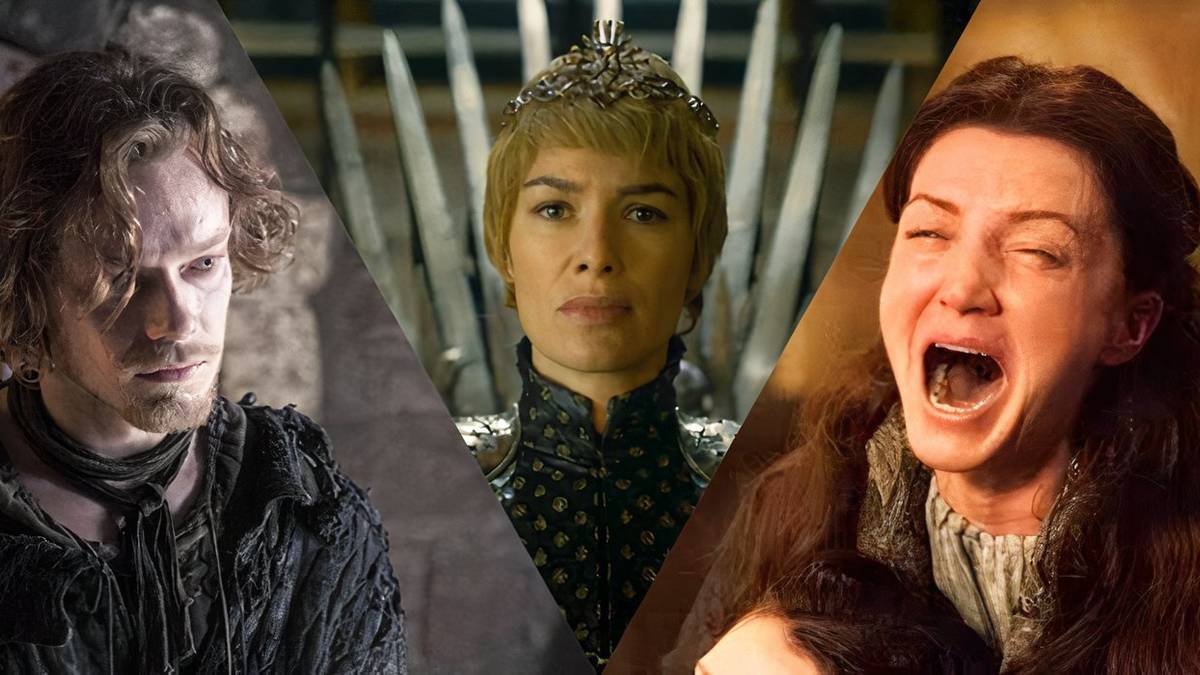
One of the great things about A Song of Ice and Fire is that George R. R. Martin rarely wastes a detail. A seemingly throwaway line can take on significance several books later, while the tiniest detail can inspire years of speculation. This created something of a problem for Game of Thrones, where the nature of an adaptation meant several planned subplots had to be abandoned because showrunners David Benioff and D.B. Weiss hadn’t laid the groundwork in early seasons. There are exceptions, of course. Martin confirmed three known theories to Benioff and Weiss ahead of filming: Hodor’s final fate, Stannis burning his daughter, and who would sit on the Iron Throne at the end.
With The Winds of Winter’s publication looking increasingly unlikely, many theories may not ever get a definitive answer. Some theories are so heavily set up that they feel almost inevitable, while others require readers to connect an intricate series of dots before arriving at an answer that, in hindsight, appears obvious. Game of Thrones addressed many of theories, but some fun, plausible theories exist that will probably never be confirmed one way or the other.
10
Jojen Paste

Jojen was something of a cipher in Game of Thrones. He arrived, said some vaguely cryptic things, accompanied Bran beyond the Wall, and then was rather unceremoniously killed off. In Martin’s books, though, he is considerably more interesting. He has greensight, and his predictions repeatedly come true, including his vision of the Greyjoy attack on Winterfell. He survives the journey to the Three-Eyed Raven’s underground lair, but upon arrival, Jojen becomes increasingly withdrawn and morose, taking on a bitter demeanor instead of being his usual affable self. Throughout the books, Jojen has dreamed of his own death and becomes increasingly convinced that his fate is fast approaching as the group near the cave, where he quietly disappears from the story.
The theory is that Jojen’s disappearance is more literal than it first appears: Bloodraven has killed Jojen and turned his body into the weirwood paste he feeds to Bran. The paste is red-veined and tastes of blood, and Game of Thrones repeatedly emphasizes that powerful magic requires blood sacrifice. This theory would make sense; Bloodraven is essentially sacrificing Jojen to awaken Bran’s supernatural abilities. If true, this is one of the more disturbing, darkly supernatural theories. It would mean that Bran has unwittingly eaten one of his most loyal friends in exchange for supernatural abilities, which is about as grim as fantasy gets.
9
The Rat Cook

Plenty of great Game of Thrones book characters were cut from the show, and Wyman Manderly is up there with the best of them. The huge Northern Lord was nicknamed Lord Too-Fat-to-Sit-a-Horse, but he masks a cunning, calculating mind. Thankfully, he is loyal to the Starks, but he maintains the illusion of being loyal to the Boltons and the Freys in the wake of the Red Wedding, which led to the death of one of his sons and the capture of another.
When three Freys visit him, Manderly observes guest right to the letter before sending them on their way. He protects the Freys while they stay with him, but crucially also marks the end of his protection by presenting them all with gifts when they leave. They subsequently vanish without a trace, and the next time we see Manderly is at Winterfell, where he presents Roose Bolton with three huge pies. Manderly then repeatedly asks the musicians to play The Rat Cook, a song about a cook who murders a king’s son and bakes him into a pie. It’s a near certainty that he baked the Freys into those pies, but Game of Thrones fans will likely never get outright confirmation. The show did nod to this theory again in Season 6, when Arya Stark cooked the Freys into a pie and fed it to Walder Frey before cutting his throat.
8
The Bolt-On Theory

Game of Thrones showed fans just how evil the Boltons were, but they’re even worse in the books. Roose Bolton is a pale, cold-eyed Lord who’s unnervingly softly spoken and always clad in a pink-lined cloak. The Bolt-On theory takes his quiet menace one step further by positing that Roose isn’t actually human. The theory suggests Bolton is a secretly an immortal, supernatural creature who has survived for generations by stealing and wearing other people’s skins.
His strange eyes, comments about his blood, the Bolton tradition of flaying their enemies, and his lack of emotion all suggest something sinister, and combined with the skin-changing abilities established in previous books, the argument becomes strangely compelling.
The theory also gives his relationship with his son Ramsay a potential explanation. It’s clear that Roose barely tolerates his son in the books and is constantly putting distance between them, which raises the question, why does he put up with him at all, let alone legitimize him? Perhaps Roose has no intention of letting his son inherit, because he plans to wear Ramsay’s skin himself. It’s a wild theory, but it’s pretty compelling because it turns Roose from just another sinister Lord into a villain who could rival the White Walkers. If the Starks are the Westeros equivalent of werewolves, then maybe the Boltons are vampires.
7
The Great Northern Conspiracy

The North may look like it has been thoroughly defeated after the Red Wedding, but A Dance With Dragons repeatedly hints that the Northern houses have not forgotten the Starks. The Boltons have been installed at Winterfell with the support of the Freys and the Lannisters, yet their position is far from secure, with Northern lords openly resentful of their new rulers and several seemingly loyal houses behaving suspiciously. The more time Theon spends in Winterfell, the more apparent it becomes that something is happening behind the scenes, with tensions rising precipitously.
The Great Northern Conspiracy theory argues that several Northern houses are secretly working together to restore the Starks, with figures like Wyman Manderly, Robett Glover, and the Umbers playing a much larger game than their apparent loyalties would suggest. Manderly in particular seems almost comically adversarial to the Freys while publicly supporting the Boltons, and his speech to Davos Seaworth suggests that he has his own plans:
“My son Wendel came to the Twins a guest. He ate Lord Walder’s bread and salt, and hung his sword upon the wall to feast with friends and they murdered him. Murdered, I say, and may the Freys choke upon their fables. I drink with Jared, jape with Symond, promise Rhaegar the hand of my own beloved granddaughter… but never think that means I have forgotten. The north remembers, Lord Davos. The north remembers, and this mummer’s farce is almost done. My son is home.”
Roose Bolton seems aware of something else going on, and he appears more on edge than at any point in Game of Thrones. If this does come to pass, though, it’s not just Roose who will be in trouble. Stannis Baratheon, currently marching on Winterfell, will be discarded by the Northmen as soon as they can supplant him with a Stark. The books could eventually reveal a full-scale rebellion hiding in plain sight, but the longer The Winds of Winter remains unpublished, the longer fans are left wondering just how much of the North’s behavior is part of a co-ordinated plan.
6
The Valonqar

In the books, Cersei Lannister received a prophecy from Maggy The Frog as a child. She learns that she will become queen, and that Robert will father 16 children, but she will only have three. Maggy goes on to make the sinister promise to Cersei:
“Gold will be their crowns, and gold their shrouds. And when your tears have drowned you, the Valonqar shall wrap his hands around your pale white throat and choke the life from you.”
Valonqar is the High Valyrian word for younger brother, leading Cersei to believe that Tyrion will be the one to kill her, which explains her hatred and fear of her brother. There is, however, an obvious problem with this interpretation: her twin Jaime is also her younger brother, as he was born a few minutes later. The prophecy has therefore spawned endless theories, but the wording “the Valonqar,” not “your Valonqar,” might mean Cersei’s killer could plausibly be any younger brother. Theories on whom this could be range from Sandor Clegane to Euron Greyjoy. What’s most interesting about the prophecy is what Cersei has taken from it and how this has informed her relationships with her brothers. Her attempts to escape the prophecy may even help bring it about.
GameRant Quiz
Easy (15s)Medium (10s)Hard (5s)
5
Euron and the Kraken

Of all the Game of Thrones characters, Euron Greyjoy is possibly the most different from the books. Rather than the randy Jack Sparrow of the series, book Euron is a nightmarish, deeply unsettling figure who has embraced sorcery and is attempting to transform himself into a god, even as he presents himself as a godly man to the Iron Islanders, albeit in a fairly ironic way:
“You serve one God, Damphair, but I have served ten thousand. From Ib to Asshai, when men see my sails, they pray.”
One theory suggests that Euron’s plans will culminate in either summoning or unleashing enormous Krakens, mythical sea creatures, which could potentially happen during the coming Battle of Blood. Much of the evidence comes from Aeron Greyjoy’s haunting chapter, “The Forsaken,” where Euron appears in a series of disturbing visions. Precisely how Euron intends to summon the creatures is less certain. Some versions of the theory suggest blood sacrifice, which is bad news for Aeron, while others connect the krakens to the broader magical ritual Euron is preparing. However it happens, the theory gives Euron the sort of apocalyptic significance his presence is building toward, transforming him from a dangerous pirate into an unnerving, sinister Lovecraftian horror.
4
Bran’s Time Traveling Influence

Bran’s time traveling is one of the more interesting theories because Game of Thrones actually established the means by which it could be made possible. As the show demonstrates, Bran has the ability to reach into the past and affect events, as shown when he accidentally caused young Wylis to become Hodor.
This theory proposes that something similar happened to Aerys II Targaryen. Bran will eventually reach into the past and inadvertently contribute to Aerys II becoming the Mad King. Perhaps Bran tries to warn Aerys about the Others, and the need to burn the bodies to destroy them. Instead, Aerys hears a strange voice from the future and becomes increasingly obsessed with fire, eventually descending into madness, with the only words coming from his mouth being: “Burn them all.”
Bran wouldn’t deliberately drive Aerys to madness; he would simply become part of the chain of events that caused it, creating a terrifying closed time loop. This is never confirmed by Game of Thrones, but it did explicitly establish that this would be possible. Aerys’s brief appearance onscreen, when he was at least vaguely aware of Bran’s presence, suggests it was at least on the cards at some point.
3
The Ghost In Winterfell

Theon Greyjoy suffered a lot in Game of Thrones. He committed some of the most unforgivable crimes, yet his journey from an arrogant child to an utterly broken servant makes him a truly pitiful character, and it’s so much worse in the books. While Theon is held by Ramsay at Winterfell, however, something strange occurs: a killer starts to attack in the darkness, murders several Freys and Bolton men-at-arms, and gains the nickname The Ghost of Winterfell. The theory is that the ghost isn’t an assassin or a Stark loyalist, but Theon himself, or more accurately, a manifestation of his own psyche.
He had been in severe psychological distress thanks to Ramsay and had even created the “Reek” persona as a result. The evidence is thin but compelling: there are large gaps in his POV chapters, where he is suffering from identity erosion, and one of these chapters is even titled “The Ghost of Winterfell.” Also, in one very strange scene in the books, Theon is confronted by a mysterious hooded figure, who seems to know exactly what buttons to press to best attack his guilt and shame. He also mocks Theon’s mutilated hand, something that connects with his former easy-going personality. Some readers interpret the meeting as Theon confronting the person he used to be – arrogant, cruel, and amused by other people’s suffering. It’s a wonderfully strange theory, and even though Ramsay thinks Theon is too weak to be the ghost, it’s compelling.
2
The Bells

One of the more interesting Game of Thrones theories involves an important book character omitted from the show: Jon Connington. During Robert’s Rebellion, Connington was Rhaegar Targaryen’s loyal second-in-command who pursued an injured Robert Baratheon to Stoney Sept, where the townspeople hid him. When the town’s bells rang out to warn the populace, Robert’s allies, including Ned Stark and Jon Arryn, launched an attack. They utterly decimated Connington’s forces and forced him to retreat. Connnigton has been haunted by this failure ever since, with the sound of bells still provoking a physical reaction from him:
“Seventeen years had come and gone since the Battle of the Bells, yet the sound of bells ringing still tied a knot in his guts.”
Now Connington is helping Young Griff invade Westeros, and the theory argues that next time he hears the bells of King’s Landing, his trauma will cause him to make a catastrophic mistake. He had spent his life believing that he failed to defeat Robert at Stoney Sept because he wasn’t ruthless enough; if he’d been willing to raze the town to the ground, he could have won the war. The theory therefore suggests that when the bells ring again, likely when he and Young Griff have begun their attack, he will potentially unleash wildfire on the smallfolk of King’s Landing, in what has been described as George R. R. Martin’s version of the Scouring of the Shire from Lord of the Rings.
1
The Night Lamp

The Night Lamp theory works as an attempt to reconstruct Stannis Baratheon’s plan for the upcoming Battle of Ice from the textual evidence scattered throughout the books. Ostensibly marching to depose Roose Bolton from his seat in Winterfell, Stannis is currently sheltering from the snow in the Crofter’s Village, which sits beside a frozen lake and has a prominent beacon. The theory argues that Stannis intends to exploit the terrain and the terrible winter conditions by creating a false beacon on the frozen lake, luring the attacking Frey forces onto the ice and then breaking it beneath them.
The sheer volume of evidence supporting this theory is what makes it so compelling. Davos Seaworth’s earlier discussion of the night lamp at Sisterton establishes the idea of using lamps as navigational markers and how the Sistermen would raise false beacons to force ships aground, while Stannis’ men have been systematically weakening the ice by cutting holes in it. Theon, who is Stannis’s captive, explains that the natural surroundings are a liability, not an advantage, and Stannis responds as only he can:
“The ground?” said Theon. “What ground? Here? This misbegotten tower? This wretched little village? You have no high ground here, no walls to hide beyond, no natural defenses.”
“Yet.”
If this theory had come true, it would demonstrate something fans have read about for six books now: Stannis’s tactical brilliance. His attack on King’s Landing was brutal, but didn’t really amount to much beyond charging at the gates. This plan, however, shows a different side to Stannis. In any case, this would have been a huge improvement on the show’s version of The Battle of Ice, which effectively had Stannis leading his men into a mass slaughter at the hands of the Boltons. The Night Lamp remains one of those tantalizing book-only possibilities that fans may sadly never get to see play out.

- First TV Show
-
Game Of Thrones
- First Episode Air Date
-
April 17, 2011
- Where to watch
-
HBO Max
