There are a ton of impressive horror filmmakers out there; Alfred Hitchcock was the prolific “Master of Suspense,” Wes Craven was dubbed the slasher innovator, and George A. Romero is often called the “father of the zombie film.” Each of these directors brought something different to the genre, and while many recent horror filmmakers have made both mainstream and cult classics, one man has managed to stand out from his peers to create one of the most impressive horror resumes in Hollywood.
Mike Flanagan is the creative mastermind behind some of the best scary movies and shows in the last two decades. Whether he’s delivering a heartbreaking meditation on grief and trauma or terrifying audiences by using sound as a tool for psychological tension, Flanagan is a force to be reckoned with. However, it seems like he mostly comes up in conversations surrounding his original TV series like The Haunting of Hill House, Midnight Mass, and Carrie. But Flanagan’s movies are not something horror fans should overlook.
8
Ouija: Origin of Evil (2016)

Set in 1967 Los Angeles, Mike Flanagan’s Ouija prequel, Ouija: Origin of Evil, follows widowed mother Alice Zander as she tries to build a better life for her daughters, Paulina and Doris, by running a phony psychic business. While using a Ouija board to make her fake séances appear more authentic, Alice accidentally summons a genuine demon spirit into their home, and her youngest daughter Doris becomes its primary target. The Zander family’s financial struggles and grief give the supernatural story a strong emotional foundation, and Origin of Evil achieved the unusual feat of outshining its predecessor.
The prequel also boasted unforgettable performances, particularly from Lulu Wilson as Doris, whose transformation from innocent child to a malicious, powerful vessel was incredibly unsettling. Flanagan made great use of the 1960s aesthetic, too, with period detail and old-fashioned studio-style flourishes giving Origin of Evil an authentic feel. Origin of Evil has less to say than some of Flanagan’s other works, but it still boasts an impressive, dread-filled atmosphere.
7
The Life of Chuck (2024)
In his third Stephen King adaptation, Flanagan stepped away from the horror genre to tackle one of the author’s more humanistic works. The Life of Chuck is a moving meditation on life, death, and everything in between, which is told in reverse chronological order. The film begins with a world seemingly nearing its end, where natural disasters and inexplicable events are accompanied by strange messages thanking Charles “Chuck” Kantz for “39 great years.” As the story unfolds, The Life of Chuck moves backward through Chuck’s life, revealing the ordinary moments, relationships, and revelations that shaped the titular character.
The Life of Chuck is a beautifully made and affecting film that explores love, loss, and what it means to wholly exist in the one life you have, but it doesn’t quite reach the same heights as Flanagan’s other works. Its reverse structure is an inspired way to explore the value of human life, and its quieter moments often hit harder than some of the movie’s more overtly emotional scenes, but its episodic structure can make it feel less cohesive than the director’s best movies and shows. Still, Tom Hiddleston is charming as Chuck, and The Life of Chuck’s memorable dance sequence is an excellent way to celebrate the fleeting joys in life.
6
Absentia (2011)

Mike Flanagan made his feature film debut with Absentia, a supernatural horror that proves just how much tension he can conjure with a low budget. Absentia follows Tricia, a pregnant Glendale resident who has decided to accept that her missing husband, Daniel, is not coming back. As Tricia prepares to declare him dead in absentia, a presumption of death, her sister offers to help out and move in with her. Things soon take a sinister turn as the sisters encounter a haunting creature in a tunnel near Tricia’s house that seems to be connected to Daniel’s disappearance.
The pedestrian tunnel is an effective setting for the film’s creeping sense of dread, turning an otherwise ordinary part of a neighborhood into something genuinely threatening. Absentia’s mythology is deliberately sparse, and some of its performances and production reflect its modest budget, but that roughness contributes to its unnerving atmosphere. It may not be as polished as Flanagan’s later works, but its compelling cast and haunting story make Absentia one of his most distinctive early films.
5
Oculus (2013)

In 2005, Flanagan released a horror short titled Oculus: Chapter 3 – The Man with the Plan, which was set in a single room with one actor alone with a mirror. 2013’s Oculus is based on the short and follows siblings Kayliee and Tim Russell across two different timelines: one in 2002 and one in 2013. In the past timeline, Kayliee and Tim are living a happy life in a new home with their parents, Marie and Alan. However, their happy home quickly turns into a circus of nightmares when their parents become possessed by a supernatural mirror that causes them to have sinister hallucinations. Devastated by the loss of their parents, Oculus then sees Kayliee and Tim tracking down the mirror in the present timeline so they can destroy it before it hurts another family.
Chapter 3 saw massive success, leading a lot of high-profile studios to bid for its contract, but Flanagan passed on any offers that forced him to turn Oculus into a found-footage feature. Eventually, Intrepid Pictures offered to produce the film and gave Flanagan complete creative control.
Flanagan manages to turn a simple haunted-object story into a genuinely disorienting psychological horror, and the shifting timeline gradually blurs the line between past/present and reality/illusion, which leaves viewers as uncertain as the characters about what they’re actually seeing. Rather than relying solely on jumpscares, Flanagan builds horror around the characters’ inability to trust their own minds, creating a clever and unsettling watch that rewards close attention.
4
Before I Wake (2016)

Before I Wake blends supernatural horror with a surprisingly tender story about childhood trauma and grief, two themes that would become Flanagan’s signature in his Haunting Netflix series. In the film, Jessie and Mark suffer the loss of their young son, who dies in a drowning accident. The pair then go on to adopt Cody, an 8-year-old orphan who seems to have bad luck with foster families. Although Cody initially seems sweet and eager to please, his new parents soon discover that his nightmares and dreams manifest physically while he sleeps. A nightmarish creature dubbed “The Canker Man” then begins to terrorize the home, and the family must figure out what the demonic force wants and how to expel it from their home.
Before I Wake is an interesting and unnerving exploration of childhood psychological scars and the lengths parents will go to to protect them. Flanagan delivers some striking imagery by turning the contents of a child’s imagination into tangible threats, which gives Before I Wake a distinct visual identity. It’s an affecting example of the director’s interest in the relationship between horror and grief, bolstered by impressive performances from its central cast.
3
Doctor Sleep (2019)

There aren’t many filmmakers out there who would volunteer to follow Stanley Kubrick’s The Shining, one of the most celebrated horror movies ever made, but Flanagan took on that challenge with Doctor Sleep. Based on Stephen King’s book of the same name, Doctor Sleep follows adult Danny Torrance, who continues to struggle with the trauma of his childhood at the Overlook Hotel. He is trying to build a stable life, using his psychic abilities to comfort hospice patients as they pass away, but his “Shine” powers end up connecting him to a young girl named Abra Stone. After discovering that Rose the Hat and her group of semi-immortals, True Knot, want to kill Abra for her “Shine,” it’s up to Danny to confront his demons and rescue her.
Doctor Sleep’s greatest achievement is how it can honor Stephen King’s source material and Kubrick’s film without letting those overwhelm Flanagan’s own vision. Ewan Macgregor is vulnerable and resolved as Danny, while Rebecca Ferguson is magnetic as Rose, whose charm makes her cruelty all the more disturbing. Doctor Sleep also manages to expand the psychic world of The Shining beyond the Overlook Hotel, with its final act returning to the hotel and delivering a potent blend of nostalgia, dread, and terror. Doctor Sleep is a rare sequel that can stand on its own while also engaging thoughtfully with an iconic original.
2
Gerald’s Game (2017)

Acting as Flanagan’s first entry into what would become a long relationship with Stephen King adaptations, Gerald’s Game is a psychological horror based on the 1992 book of the same name. Translating the story from book to screen was a daunting task, given how much of the narrative happens within the protagonist’s mind, but Flanagan turned the confined premise into a gripping and hypnotic watch. In Gerald’s Game, Jessie and Gerald Burlingame hope to rekindle their seemingly broken marriage and set off on a mini-vacation in an isolated lake house in Fairhope, Alabama. During a moment of intimacy, Gerald ties Jessie’s hands to the bedposts but soon suffers a heart attack, leaving Jessie completely alone and unable to break free of her restraints.
Dehydration and exhaustion begin to take their toll, and Jessie begins experiencing disturbing hallucinations and memories of her childhood abuse. Carla Gugino brings much of Gerald’s Game’s horror through Jessie’s shifting emotions, as fear, anger, shame, and determination all compete for control. Flanagan makes excellent use of the small setting, transforming an ordinary bedroom into a nightmarish space where Jessie’s own mind is just as threatening as her predicament. As Jessie tries to break free of her handcuffs, she also makes genuine attempts to regain control of her life and emotions, leading to a grueling climax.
1
Hush (2016)

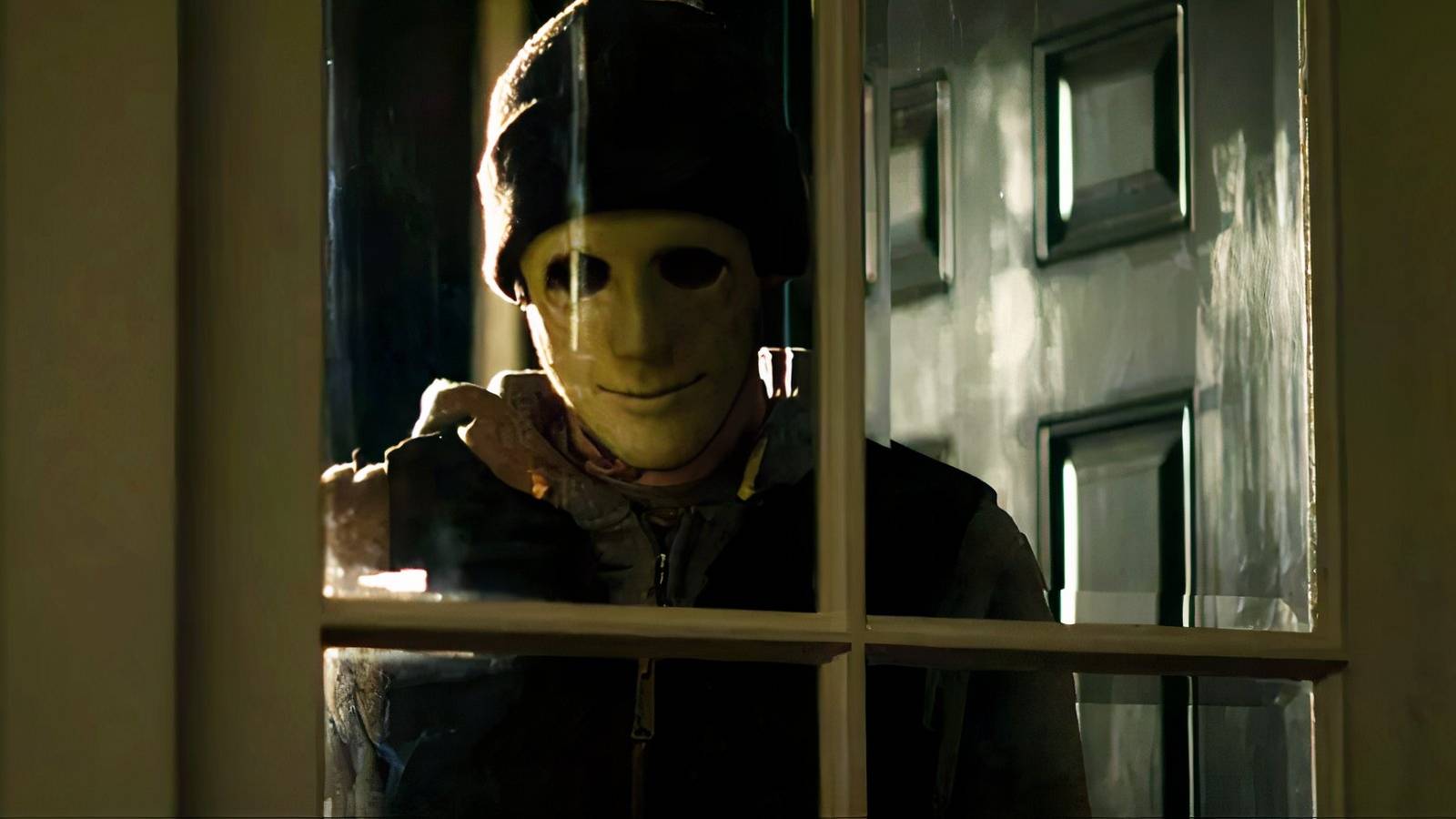
Mike Flanagan strips back the home-invasion horror movie to its most basic elements in Hush, a tense thriller about a writer who’s unable to hear or speak and must fight for her life when a killer appears outside her home. Flying high on the critical success of her novel, horror author Maddie Young ditched the hustle and bustle of New York City for a house in the isolated woods. Her peace is quickly disturbed when she realizes a masked man is outside her home, and though he seemingly has the upper hand, Maddie uses her intelligence and resourcefulness to outwit her attacker. The simple premise allows Hush to build tension through small decisions, quick thinking, shifting tactics, and the increasingly desperate struggle for survival.
Maddie moves to the woods after the success of her novel, Midnight Mass, a nod to Flanagan’s Netflix series.
By placing viewers in Maddie’s position, Hush turns familiar horror conventions into something more unpredictable, while its carefully staged cat-and-mouse game builds almost unbearable suspense. Kate Siegel does exceptionally well without dialogue, and the result is an intense, lean thriller that shows just how much horror Flanagan can bring without an ensemble cast or elaborate mythology.

- Release Date
-
April 8, 2016
- Runtime
-
82 Minutes
- Director
-
Mike Flanagan
-

John Gallagher Jr.
The Man
-

-

-

