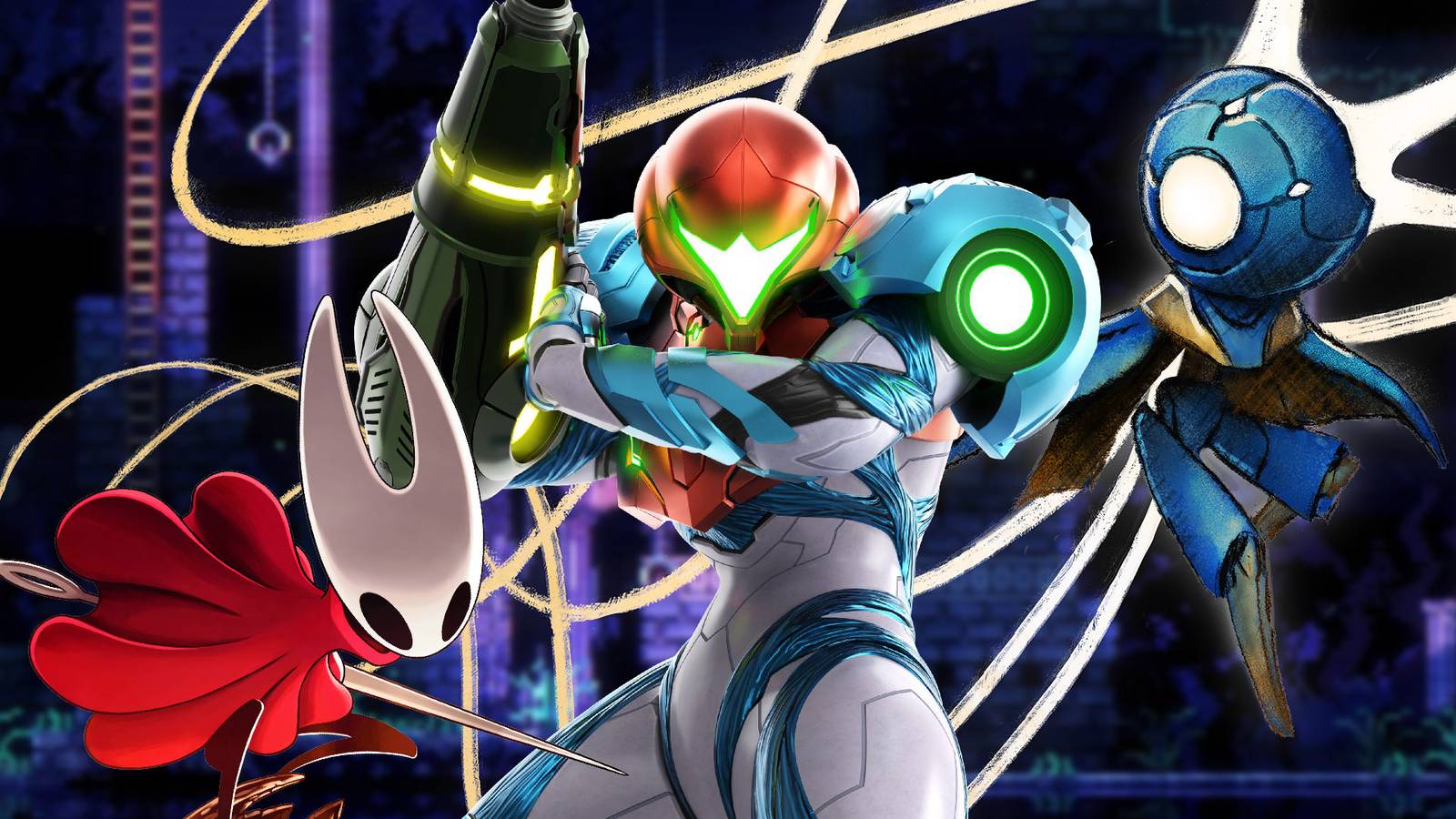
It’s never been a better time to be a Metroidvania fan. From Hollow Knight and Ori and the Blind Forest in the 2010s to the genre overload of the 2020s, any gamer who is looking for the next great Metroidvania won’t have to look too far. Pretty much anything you pick up these days is going to be a good time.
However, there’s “a good time,” and then there’s the best Metroidvanias of the decade. These games are a cut above, and not only perfectly capture what makes this 2D genre special, but innovate on it in surprising and wildly successful ways. From gorgeous visuals to crisp movement and addictive combat, these Metroidvanias are the best you’ll find from the 2020 era.
We’re only looking at true Metroidvanias here, so games with Metroidvania elements like God of War Ragnarok, Control Resonant, or Star Wars Jedi: Survivor won’t make the list, even though they’re all great games.
Hollow Knight: Silksong
At Long Last
It was a long time coming, but Hollow Knight: Silksong lived up to every bit of hype it generated in the years following its announcement. Whether it’s better than the first Hollow Knight is up for debate, but it’s certainly not far off. I personally think Silksong is vastly superior narratively, and equally as good from a gameplay perspective.
Team Cherry’s art is as gorgeous as ever, as is Christopher Larkin’s musical score, but Silksong has so much more going for it. From buttery smooth platforming to a brilliant and complex pogo mechanic to an incredible third act that is easily the most cinematic gameplay I’ve ever seen in a 2D game, Hollow Knight: Silksong lived up to its predecessor and joined its ranks as one of the greatest Metroidvanias of all time.
Metroid Dread
Risen From The Grave
Touted as the final chapter in the mainline Metroid series (we’ll see if that still holds with Metroid Ravenous on the way), Metroid Dread was in development purgatory for a long time. It was even directly named way back in Metroid Prime 3. Yet after all that time, it finally launched on the Nintendo Switch and delivered the brilliance of 2D Metroid games to the modern-day player.
Metroid Dread pretty much nails everything you’d want from a Metroid game. It’s perfectly paced, hands out a ton of weapons and traversal abilities, and strikes a fine balance between making Samus feel vulnerable and making her feel like a badass. Spectacular boss battles and head-scratching puzzles are just the beginning. Metroid Dread is a tough game, refusing to hold your hand and demanting both careful progression and deliberate backtracking. Given the relatively meek response to Metroid Prime 4, Metroid Dread is currently the best way to experience the series’ modernization.
Silver Pines
Twinning
It’s rare for a genre mashup to work as well as Silver Pines does, but when it does, it has the makings of a classic. Part Metroidvania, part survival horror, Silver Pines draws heavily on Twin Peaks and Silent Hill for its world design. The entire game is set in the titular town of Silver Pines, and you explore it area by area, acquiring new weapons, keys, and safe codes while on the hunt for Eddie Velvet, whom you’re meant to kill.
There’s even a little Legend of Zelda sprinkled in, as you only find new abilities in the areas where you need them. That also tweaks your typical Metroidvania exploration loop, since you’ll typically start an area by heading straight for your main objective, and then exploring with your newly unlocked ability afterward. Meanwhile, you’ll be managing your inventory constantly, in true survival horror fashion. Silver Pines really is the best of both worlds. It’s one of the year’s best horror games, but it’s also one of the most interesting takes on the Metroidvania genre in quite some time.
Castlevania: Belmont’s Curse
Back In Business
If Silksong was a long time coming, then Castlevania: Belmont’s Curse is like witnessing the dead coming back to life. If we ignore remasters and ports, the most recent 2D Castlevania game was 2013’s Castlevania: Lords of Shadow – Mirror of Fate, a Nintendo DS exclusive entry in the “reboot timeline.” It was not well-received by fans or critics. The good news is that Castlevania: Belmont’s Curse has righted that wrong and restored the series to its former glory. Set following the events of Castlevania 3 and heavily inspired by the Netflix animated series, this is a truly modern Castlevania game, and it’s all the better for it.
Taking pages from Hollow Knight, Dead Cells, and even Hades and Disco Elysium, Castlevania: Belmont’s Curse plays like a dream, with phenomenal movement and combat controls and a genius Tarot card mechanic that gives you hints about new abilities to acquire, ways to upgrade those abilities once you unlock them, and associated characters who speak to Rose as she explores Dracula’s castle. It may not feel exactly like those old-school Castlevania games from your childhood, but I promise you, Castlevania: Belmont’s Curse is exactly the shot of electricity the series needed to get back on its feet.
Prince Of Persia: The Lost Crown
Time’s Up

Another series revival that no one expected to be this good, Prince of Persia: The Lost Crown reinvented the franchise, going from a 3D action platformer, and previously a 2D action platformer, to a straight-up Metroidvania, complete with clever QoL innovations in the genre’s typical map design. A simple tweak makes it so that any markers you put down on the map include an in-game screenshot of that room, so you can look back and see if you have the ability needed to solve its backtracking puzzles.
The Lost Crown is more than just an innovation in map design, though. From gorgeous animations and epic boss fights to some of the most jaw-dropping level design you’ll see in the 2D space this decade, this iteration of the Prince of Persia series sought to elevate not just the IP, but the entire genre. Unfortunately, Prince of Persia: The Lost Crown did not sell well enough to meet Ubisoft’s expectations, and its development team was disbanded. That means that this is almost certainly a one-and-done release, but it’s a special one and is not to be missed.
MIO: Memories In Orbit
You’ve Never Seen Anything Like It

On the subject of gorgeous animation, MIO: Memories in Orbit is easily the best looking Metroidvania of the decade. Yes, its watercolor art style is unique and leaps off the screen, but it’s the movement animations that will make your jaw drop. You will likely never play a game that looks like MIO again, and that’s a good thing, because it could never live up to the same standard.
MIO does Metroidvanias a little differently. It’s almost like a cozy game, and between its music and its gameplay, it’s kind of zen. The focus here is far more on exploration and platforming than combat, although the latter does make regular appearances. It’s a game that lulls you into relaxation before throwing a tough-as-nails boss fight your way. Difficulty spikes are absolutely worth being aware of (and prepared for), but they’re a small hindrance in what is a stunning sci-fi Metroidvania that does everything in its power to stand out in a crowded genre.
Ori And The Will Of The Wisps
Prepare To Cry
Following in the emotionally devastating footsteps of its predecessor, Ori and the Blind Forest, Moon Studios’ second game, Ori and the Will of the Wisps is a firmly faithful sequel that doesn’t try to reinvent the wheel. Instead, it shows off what the franchise can accomplish on modern consoles. It’s bigger, more detailed, and more complex, while reminding you exactly why you loved the first game back in 2015.
There are so many movement abilities to unlock that by the end of the game you’ll feel like you’re flying across the map. The same goes for combat, and it’s all doled out at a perfect pace, letting you slowly ramp up to mastering all of it during some of the game’s boss battle set pieces. And yes, Ori and the Will of the Wisps will make you weep with its story, just like the first game did. It’s gorgeous, moving, and a perfect companion to the first game that makes this one of the best Metroidvania series of the modern era.
Nine Sols
Parry This, Casual

If you’re not a fan of parry mechanics, this one might not be for you, but if you enjoy them, and especially if you’re a fan of games like Sekiro: Shadows Die Twice, then Nine Sols is a must-play. It’s hard, don’t get me wrong. There are some fights in this game (particularly its infamous final boss) that test your limits, but it always keeps things fair. Nine Sols may demand perfection, but it always ensures that perfection actually feels attainable.
Contrary to MIO: Memories in Orbit, Nine Sols is heavily focused on combat. Exploration is involved, but it’s pretty minor. Good thing the game’s combat is stellar, with attacks, parries, and a standout Talisman mechanic that makes you feel like a total badass when you pull it off. Nine Sols will also switch up genres on you unexpectedly, throwing startling horror levels or some high-concept sci-fi your way to keep things fresh.
Animal Well
Let’s Not Fight

For a Metroidvania almost completely devoid of combat, Animal Well is ridiculously engrossing. It’s more of a puzzle game than anything, with screen after screen of basic, surface-level puzzles that are meant to both teach you the rules of the game world and also distract you from the trickier and much more complex puzzles hidden in the background. Animal Well is already more than two years old, and fans are still digging through its map to find any shred of secrets that are yet to be uncovered.
Instead of giving you a bunch of abilities and a world to use them in, Animal Well ties its mechanics to animals, which you’ll find throughout the world. Each animal has a set of rules that denote a way for you to solve their room’s puzzle, and piecing together those rules is a deeply satisfying experience. While its minimalist visuals may not inspire much from a screenshot or two, seeing the game in motion is another thing entirely. Be prepared to get sucked into Animal Well and its secrets, because it has a ton to offer players who want to really sink their teeth into it.
Blasphemous 2
Aren’t You Sorry?

While the first game is a great Metroidvania in its own right, Blasphemous 2 takes everything its predecessor did and improves on it, adding and expanding gameplay mechanics while sanding down rough edges to make for a smoother experience. The Penitent One and his giant pointy hat return once again, doling out judgment throughout this Biblical horror kingdom of Cvstodia.
Movement and combat are as tight and responsive as ever, but instead of just one weapon like in the first game, in Blasphemous 2, you have three, which you can freely switch between depending on what each combat encounter requires. Boss battles are as visually stunning as ever, with designs that fluctuate between grotesque and gorgeous. Half the fun is piecing together the lore and story being told, and Blasphemous 2 once again masterfully delivers this information in ways that are just cryptic enough to make you think, but not so obtuse that you’ll never understand what’s happening. It’s a perfect example of the soulslike formula working within the Metroidvania genre, but thanks to a more forgiving difficulty curve, it makes for a solid entry point for newcomers as well.
