
The best thrillers keep audiences on the edge of their seats, constantly guessing where the story might go next. Some might rely on relentless action and suspense, while others rely on subverting viewers’ expectations, mysterious characters, and shocking revelations. There’s nothing wrong with a straightforward thriller, but the ones that challenge assumptions and deliver unexpected surprises leave a lasting impression.
The best thrillers kept audiences guessing for decades, though there are some more recent entries in the genre that prove these films still have plenty of tricks up their sleeve. From intricate crime mysteries to psychological mind games, these 10 thrill rides make it almost impossible to predict what’s coming next.
10
Gone Girl

David Fincher has directed some of the greatest movies in the thriller genre, but the one that stands out for its genuinely surprising plot twists is 2014’s Gone Girl. Ben Affleck and Rosamund Pike play a married couple, Nick and Amy Dunne, whose lives change when they become the center of a wildly disturbing criminal investigation. When Amy goes missing, law enforcement suspects her husband, Nick, to be the perpetrator, but not everything is as it seems.
Gone Girl is based on Gillian Flynn’s bestselling novel, and Fincher’s film adaptation is relatively faithful to the source material, featuring many of the same gripping twists, turns, and thriller trope subversions. Halfway through, the narrative shifts from a conventional whodunit mystery to a psychological war of manipulation, and with two unreliable lead characters, Gone Girl is brilliantly impossible to predict. Whenever viewers think they have an answer to the central mystery, Gone Girl quickly throws them for a loop.
9
The Housemaid

One of the more recent thrillers that audiences found difficult to predict was last year’s smash hit, The Housemaid. Sydney Sweeney plays Millie, a live-in maid for the wealthy Winchester family. The seemingly perfect household quickly reveals a string of troubling secrets, and The Housemaid isn’t afraid to use shifting perspectives or concealed motivations to make it difficult to know who to trust.
The story encourages viewers to make assumptions about each of its characters, but then quickly challenges those same assumptions until they don’t know what to think. Even when audiences feel they have it figured out, another surprise waits around the corner. The Housemaid grossed over $400 million worldwide, and a highly anticipated sequel is in production. Fans of Freida McFadden’s book series might already be aware of some of the twists and turns planned for the next chapter in the saga, but the movie version is bound to spring a few surprises on viewers.
8
Memento

Christopher Nolan burst onto the scene with the twisty, unconventional thriller Memento back in 2000. Guy Pearce plays an insurance investigator called Leonard, who suffers from amnesia and is trying to hunt down his wife’s killer. With only Polaroids, notes, and tattoos as clues, his search for the truth unfolds in non-chronological order, which makes it impossible for audiences to distinguish between cause and effect.
Memento’s reverse-chronological structure means audiences are frequently witnessing the consequences of decisions before discovering the situation that produced them, and Leonard’s inability to form new memories further complicates matters. Memento forces audiences to question almost everything they’re told, and even when individual revelations seem predictable, the larger picture remains elusive because the film is constantly rewriting how earlier events should be understood.
7
The Sixth Sense

Before the release of M. Night Shyamalan’s 1999 classic, The Sixth Sense, Bruce Willis was known for being one of the biggest action stars around, largely thanks to his role as John McClane in the Die Hard franchise. However, audiences got to see a different side of the actor in The Sixth Sense, where he played tortured psychologist Malcolm Crowe. The opening sequence kicks off with one of Crowe’s former patients shooting him, before a time jump to the next fall shows him beginning a new assignment: helping nine-year-old Cole Sear (Haley Joel-Osment), who ‘sees dead people’.
M. Night Shyamalan uses subtle clues, carefully constructed conversations, and the audience’s own assumptions to disguise The Sixth Sense’s bigger picture, and its biggest surprises are concealed within what seems like a straightforward supernatural drama. Shyamalan has now made plot twists part of his signature style, and Bruce Willis would once again collaborate with the director on the 2001 hit Unbreakable and its two sequels, Split (2017) and Glass (2019).
6
Shutter Island
Martin Scorsese’s gripping psychological thriller, Shutter Island, is easily one of the best movies in his impressive filmography, but it’s also the most puzzling and difficult to figure out. Set in the 1950s, Leonardo DiCaprio plays US Marshal Teddy Daniels, who visits an asylum on a secluded island to investigate the disappearance of one of the patients.
Every possible solution feels simultaneously plausible and suspicious, and increasingly unsettling discoveries force audiences to question the institution, its staff, and even the investigation itself. Scorsese deliberately blurs the lines between reality, conspiracy, and potential trauma, concluding Shutter Island with a shockingly clever ending. The movie only gets better with repeated viewings, as audiences can piece breadcrumb clues together.
5
Fight Club

Even though we have to break one of the most famous movie rules of all time, let’s talk about Fight Club. Edward Norton’s unnamed narrator meets Brad Pitt’s Tyler Durden on a flight, with the two polar opposites becoming firm friends and eventually setting up a secret underground fight club. The movie presents itself as a provocative examination of masculinity and consumer culture, which makes its increasingly unpredictable narrative especially effective.
David Fincher scatters bizarre details throughout Fight Club, but they’re easy to overlook amid its anarchic energy, chaotic story, and dark humor. Despite bombing at the box office, perhaps the film’s greatest strength is how it’s able to lead audiences to a specific conclusion, without them ever questioning their own assumptions, and delivering one of the most talked-about endings in movie history.
4
On the Line

One the Line is a Mel Gibson thriller that seemingly flew under the radar when it was released back in 2022, but it has one of the best twists ever. Elvis Cooney has the midnight slot at radio station KLAT when a man calls him live on air and claims to have taken his family hostage. The apparent hostage situation becomes a desperate struggle for survival, but On the Line refuses to settle into a conventional thriller formula by introducing unexpected developments that repeatedly change the stakes.
While watching, the audience’s understanding of the situation shifts dramatically, particularly during its final stretch. On the Line is somewhat reminiscent of David Fincher’s 1997 thriller, The Game, which equally tricks the audience into believing a false narrative. Whether each On the Line twist feels earned is entirely debatable, but it’s still difficult to predict.
3
Se7en
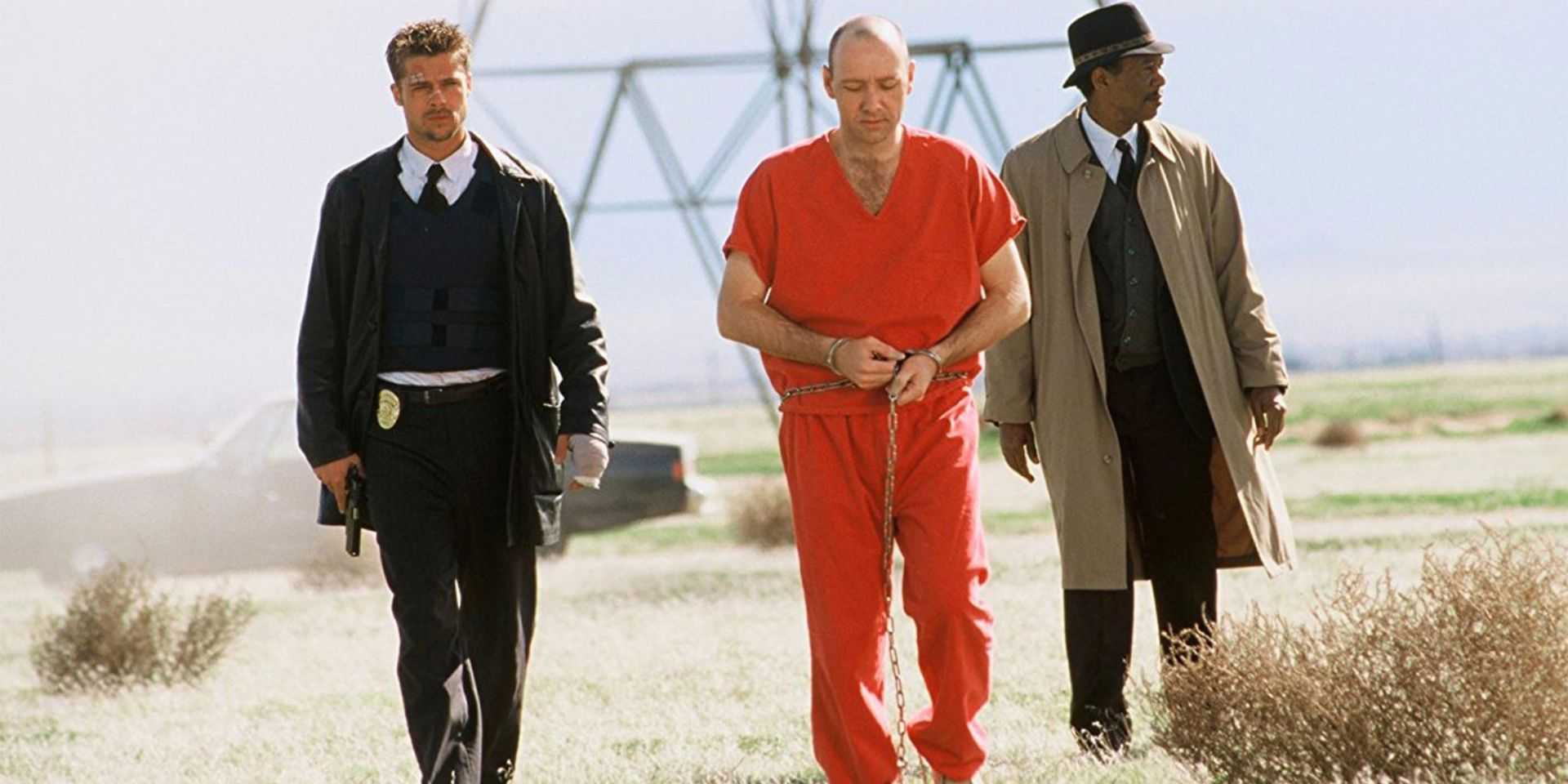
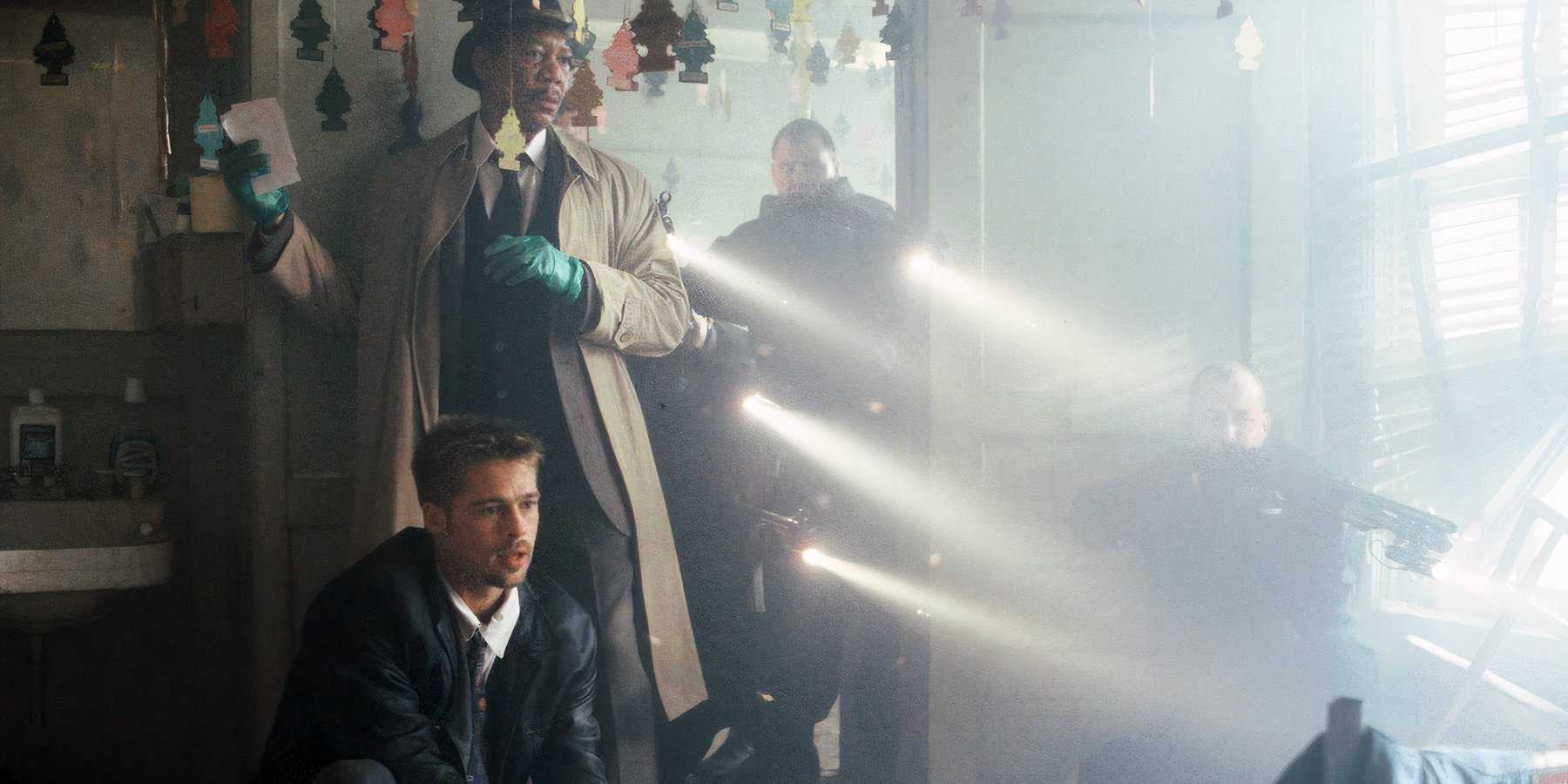
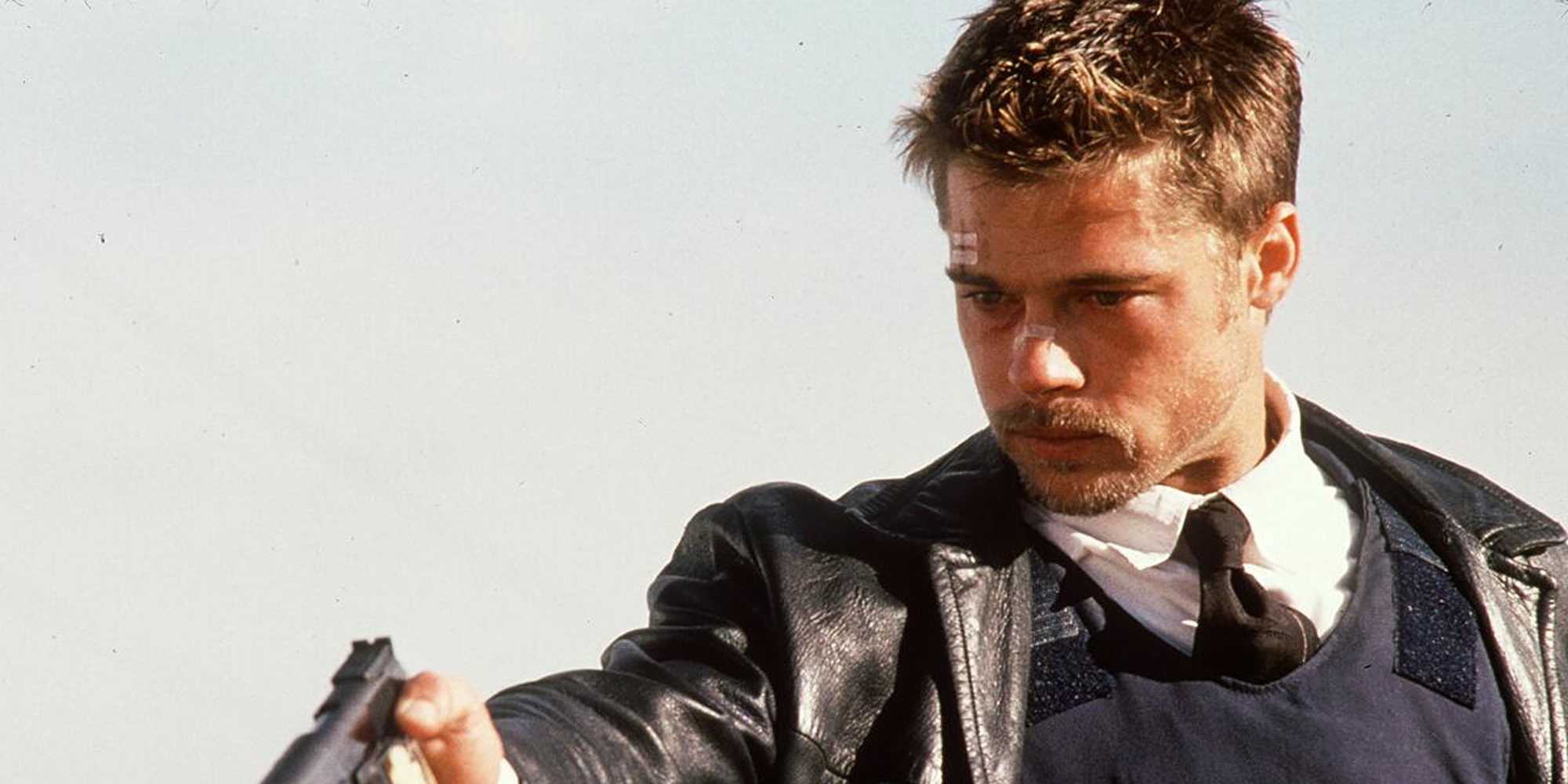
David Fincher’s Se7en was groundbreaking when it released in 1995. It could have quite easily been a run-of-the-mill serial killer thriller in lesser hands, but it took an interesting approach by not waiting until the bitter end to reveal the killer’s identity. Detectives Somerset (Morgan Freeman) and Mills (Brad Pitt) are tracking a gruesome murderer whose killing method is based on the seven deadly sins, and the investigation’s increasingly disturbing direction is impossible to predict.
Even when Mills and Somerset seem to be gaining control of the situation, and John Doe’s identity is revealed, the case takes another unexpected turn. Fincher’s keen attention to detail, the stars’ outstanding central performances, and a shocking twist ending all cemented Se7en as a masterpiece. From the bleak atmosphere alone, audiences know that something terrible is on its way, but it’s impossible for them to ever know what’s coming.
2
The Mist

Back in the mid-to-late 2000s, it felt like Thomas Jane had a clause in his contracts that stated he could only play a bereaved family man after he took the lead role in both The Punisher and Frank Darabont’s adaptation of Stephen King’s novella, The Mist. Although its mysterious creatures provide plenty of terrifying surprises, The Mist’s ingenuity lies in the survivors’ desperate decisions, which they make while they’re trapped in a supermarket.
Fear and paranoia quickly take hold, and the danger posed by ordinary people quickly becomes just as terrifying as whatever lurks outside. Frank Darabont strips away the few comforts that are typically left in a survival thriller and delivers a brutal ending, but also one of the best in the thriller genre.
1
The Usual Suspects

The release of The Usual Suspects in 1995 forever etched the name Keyser Söze into the public consciousness. Directed by Bryan Singer before his foray into superhero movies, the edgy thriller focused on the police interrogation of conman Roger “Verbal” Kint (Kevin Spacey), who miraculously survived a massacre on a ship docked in the port of Los Angeles. Spacey’s unreliable narrator takes the audience on a wild, confusing journey, and viewers are consistently led to believe they’re piecing together a complicated criminal conspiracy.
Kevin Spacey’s masterful performance as Verbal Kint landed him an Oscar for Best Supporting Actor, and The Usual Suspects introduces a web of criminals and conflicting accounts through Kint’s recounting of events. Every piece of information the audience receives is carefully controlled, making it incredibly difficult to distinguish genuine clues from deliberate misdirection. The Usual Suspects represented the best of independent filmmaking in the 1990s and launched the career of regular Tom Cruise collaborator, Christopher McQuarrie, who penned the screenplay.
