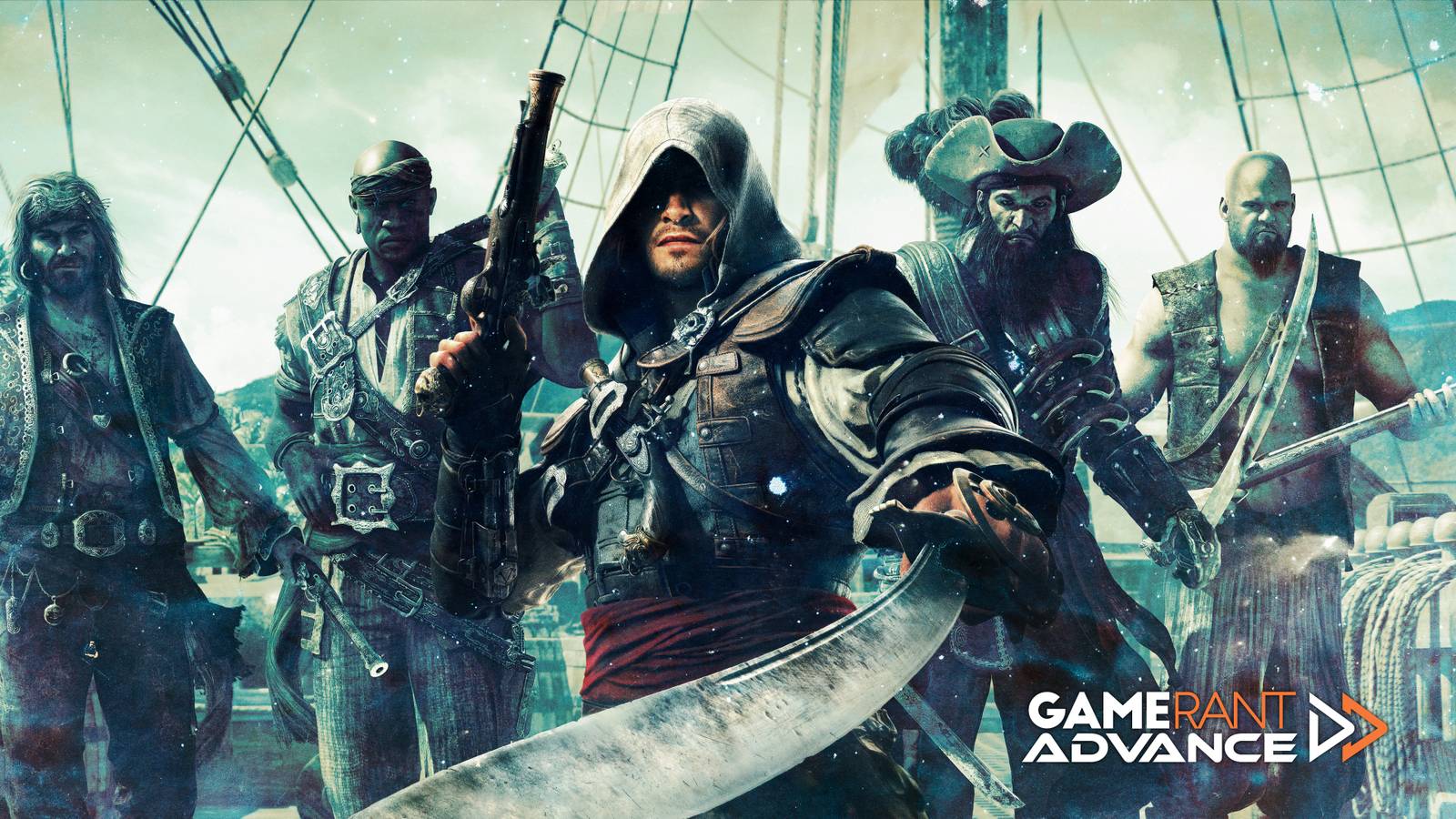
14 years ago, Assassin’s Creed 3 was released and brought Desmond Miles’ original storyline to an end. Unbeknownst at the time, it also kicked off the North American Saga that further included Assassin’s Creed Liberation, Assassin’s Creed 4: Black Flag, and Assassin’s Creed Rogue. Assassin’s Creed 4: Black Flag would release the year after AC3 and quickly become a fan-favorite in the franchise, not necessarily for the way it handled the core mythos (Assassins and Templars), but for how it explored the Golden Age of Piracy. It had the job of following the end of Desmond’s story, picking up a new saga, and introducing a brand new cast of characters, and while there are plenty of critics of Assassin’s Creed‘s post-Desmond modern-day story, Black Flag 2013 undeniably accomplished those key tasks with aplomb.
Now, Assassin’s Creed Black Flag Resynced has been released in a similar, albeit slightly different context: a possible transitional phase or change to how the franchise works. After all, Assassin’s Creed Black Flag Resynced is the first full-blown franchise remake in an industry that loves them. AC Mirage and AC Black Flag Resynced are the only mainline non-open-world RPGs since AC Origins in 2017, and Assassin’s Creed Hexe is believed to be yet another non-open-world RPG experience, to say nothing about the rumored/leaked slate of upcoming Assassin’s Creed games. In many ways, AC Black Flag Resynced represents the modern duality of the franchise’s development, its past and its present (if not officially its future), and even its fandom.
For Game Rant Advance, we spoke with Ubisoft Singapore about choosing to remake Black Flag Resynced and Kenway’s duality in the original 2013 game and in this latest remake. Beyond Ubisoft Singapore’s own take on the beloved game(s), it’s hard not to see Edward Kenway’s duality reflected in the franchise’s past, current direction, and fans.
Exclusive Art of Assassin’s Creed Black Flag Resynced
Why Remake Assassin’s Creed Black Flag 2013
If Kenway had a Pence for every time someone asked why Black Flag was being remade (while he lived in Bristol with his wife, Caroline Scott) rather than an earlier game in the franchise, he would never have left her to engage in piracy. Or at least, he would have lost all justification. Before he was an assassin or a pirate, Kenway was a dreamer: a man hoping for a better life for himself and his wife. The duality of his dreams is that he ignored the good life he had. Kenway tells Jennifer, his daughter, that he thinks he wouldn’t have left Caroline had he known, but the weakness of the claim betrays his inner turmoil. Before Kenway was an assassin, before Kenway was a pirate, before Kenway was an unusual Assassin-Pirate hybrid, he was a dreamer who was not sure of what he dreamt.
AC Black Flag 2013 Art
Kenway’s duality is partially why he’s so popular. He doesn’t dream of a world without gold, like Blackbeard, but neither does he fully buy the lies he tells himself about what morals should dictate the world. This duality serves as the mind that cannot understand, at least for a time, the wisdom of the Creed or the danger of the Templars. This duality serves as the heart of how he becomes caught up in the Assassin-Templar War, enabling and harming both sides for a time. This duality serves as the soul that sees itself as honoring its marriage in God’s eyes while committing many mortal sins in them as well. And this duality of storytelling, set to a beautiful Caribbean backdrop, argued for its own remake. The characters, the setting, the gameplay, the pirate fantasy—all these elements were, in and of themselves, enough reason for Ubisoft Singapore to explore a remake, adding,
“We had a team that had worked on the original game before so it felt like a great fit to explore doing a remake for Black Flag.
Ubisoft Singapore spearheaded AC Black Flag Resynced, getting support from other Ubisoft studios (as is usually the case for major Ubisoft games), but, as importantly, it leveraged its own skills when it came to naval gameplay. For those unfamiliar, Ubisoft Singapore has worked on the company’s naval gameplay, water tech, and ship creation/building since Assassin’s Creed 3. Upgrades to the Anvil Engine were particularly exciting because Assassin’s Creed Shadows‘ weather system fit at-sea and even on-land gameplay for AC Black Flag Resynced perfectly, while Skull and Bones (as well as other projects) helped Ubisoft Singapore “harness and strengthen” its expertise on naval-related mandates.
“Each game poses its own design and tech challenges, and for Resynced, the key was for us to revisit the original naval experience on Black Flag and see what we can further expand/push on. The inclusion of secondary firing modes as well as the addition of naval officers are examples of that.”
Fitting the duality of Assassin’s Creed Black Flag, the decision to remake the 2013 game is both simple and complex. It’s a great game, Ubisoft Singapore had the skills, and a combination thereof led to leveraging original teams and new folks across Ubisoft’s portfolio of studios to make a game that many have praised. As I wrote in my Assassin’s Creed Black Flag review, it feels like Ubisoft has never been creatively better at video game design, even for a remake, and so the handful of factors at play here truly came together for something special.
AC Black Flag 2013 Screenshots
Yes, the 2013 game is not the oldest-feeling title in the franchise, but at this point, the franchise has been around for nearly 20 years. Some of the older games are just old, and Ubisoft Singapore has always had a special connection to Black Flag. It’s that simple.
Edward Kenway: The Pirate vs. The Assassin

Setting the why aside, the next question becomes how? A dreamer like Kenway can come up with a lot of reasons to leave his wife, to take to sea, to engage in piracy, but the how of it all is the bigger question. In the original 2013 game, the “how” became this weird duality where Kenway was not an assassin, but a bona fide pirate in his lore, yet he played like an Assassin as strong and effective, if not better, than Connor, Ezio, and Altair. Fans have seen a ton of protagonists—from Assassins and Templars to Medjays and Misthios—but Kenway is the only pirate. That duality in his identity, to Ubisoft Singapore, was important:
“That duality is also key in Resynced. It is what makes Edward unique as a character and how we see him as an outsider (not yet an Assassin) for most of the story. As a player, I think this makes him relatable and compelling as we discover the Creed together with Edward, both narratively and gameplay-wise.”
I’d argue that duality in gameplay remains one of the best improvements in Assassin’s Creed Black Flag Resynced; Kenway feels like a pirate with a Hidden Blade, not a Master Assassin for no reason, who’s actually a pirate. He’s a bloody scoundrel who cheats, who fights unfairly, who creates openings to quickly take down his enemy.
And when he can sneak up on them, he’ll assassinate them too. Ubisoft Singapore didn’t set out to remove the duality of Kenway’s combat entirely, but did set out to give players “a more deterministic approach,” adding,”
“Players must learn, understand, and adapt to the archetypes that they are fighting. The goal was to provide satisfying takedowns/contextual takedowns when the player succeeds, improve tools usage in combat (like the rope dart), and offer challenges to our players so they have to be mindful of how to tackle groups of enemies with various configurations.”
The contextual/deterministic approach not only brings out more of Edward Kenway’s character in gameplay, but it also makes the combat feel more realistic. The removal of Hidden Blade combat understandably upset many fans, but in all fairness, beyond the fact that it was in the 2013 remake, it has never made sense for Kenway to be as adept at Hidden Blade combat as he is when other Assassins spend years in training. It’s a touch of ludonarrative dissonance that most fans hand-wave away because it’s a defining part of the overall franchise identity.

Yet, it also trivialized a lot of the earlier games. If Ezio Auditore were a real person who lived the way fans could play him, then he would be a mass murderer and serial killer who strung together assassination after assassination in massive groups of foes for a living. That doesn’t mean fans aren’t entitled to feel a certain way about it or that the ludonarrative element is a catch-all explanation, but it does suggest that Kenway has always been a dual figure, and this makes it feel less like two extremes.
That does not mean Ubisoft Singapore ignored key pillars of the Assassin’s Creed franchise, however, as anyone who has played the game can attest. As Ubisoft discussed Parkour and Stealth,
“We tried to bridge the gap between the parkour system in AC Shadows and the original Black Flag. The inclusion of manual jumps, side and back ejections, and corner swings helped bring back some of the flavor from the OG game while providing more player control over the various moves they can perform. In terms of stealth, we adapted what was in AC Shadows and also elements we thought could modernize the stealth experience: the manual crouch button, the inclusion of light and shadows, dynamic time of day and weather, as well as bringing back tools like the sleeping and berserk darts to help expand the Assassin’s arsenal.”
Past vs. Present, Classic vs. Modern

In Kenway, we experience the growth of a pirate who loves “freedom” for selfish reasons into an Assassin who understands the responsibilities and implications of freedom on society. In Black Flag Resynced, we experience past features that the franchise has largely moved on from, while also enjoying modern features common in most modern Assassin’s Creed games. In that, it is a certain kind of duality not dissimilar from Kenway’s own inner duality, nor the fandom’s, for that matter. Some fans will swear and die by the classic action-adventure Assassin’s Creed games, while the open-world Assassin’s Creed RPGs also have their own die-hard fans. Navigating this duality could not be simple, and it factored into every decision.
As Ubi explained, the studio wanted to “focus” on iterating and improving on the core content “by adapting and modernizing the mechanics and question scenarios, one example being the improved tailing segments.” As such, the classic content met modern design sensibilities. “For new content, we looked at elements that deepened the story” and provided “conclusions/closure to our beloved characters.” With Bonnet, players see Kenway get closure on his friendship with the Gentleman Pirate. With Blackbeard, players see Kenway bear witness to Blackbeard’s philosophy and avenge him in the World Without Gold chapter. In it, Kenway deals with the historical figure and killer of Blackbeard, Robert Maynard, and adds content that feels like it should have always been in the 2013 game.

Perhaps that is the greatest element of duality in Assassin’s Creed Black Flag Resynced. For every modernized classic feature, for every present addition to the game’s “past,” it all feels like it always belonged and was always there in the first place. In that, we see the logical progression of Assassin’s Creed‘s duality. The franchise’s classic approach belongs, even in 2016, right alongside its open-world game approach. Fans of one or the other game genre deserve to stand side by side. Every distinct part should feel as if it belongs to the whole, and that finds its home in Assassin’s Creed Black Flag Resynced‘s modernized-classic, present-past take on the world of the Caribbean.
If rumors and leaks are to be believed, action-adventure-style games, open-world games, and remakes are all key elements of its future. Ubisoft understandably would not comment on future, unannounced games, but if true, this is just one more way that the duality of Edward Kenway and of Black Flag Resynced is emblematic of the franchise’s past and future.
Of course, it’s worth noting that this feeling that everything belongs in Assassin’s Creed Black Flag Resynced is not a coincidence. Ubisoft Singapore said it was important for the company to perform this balancing act in gameplay and narrative, not just for Blackbeard’s new content, but for everything introduced for new characters: “It was important for us to get all these characters right: Blackbeard, James, Anne, Ade, etc., just as players remember them. Our writers paid particular attention when writing additional dialogues for them, especially with the new scenes where we strive to make them indistinguishable from existing lines from the original game.”
Edward Kenway Didn’t Dream of a World Without Gold

When Kenway left Caroline and his unborn daughter, he didn’t dream of a World without Gold—he dreamed of thriving in a world thanks to gold. It is this love of gold that so defined, and arguably corrupted, his dreams. When he meets Jennifer, Kenway is not certain he would not have left in pursuit of gold. What keeps Kenway away from the Creed is the desire for profit, and what keeps Kenway from returning home to Caroline, even when he’s built enough of a “fortune” to accomplish his goals, is the knowledge that his obsession is wrong. Fitting of the modern meme to the 2013 game, it’s only when Kenway realizes that the real gold was the friends he made—and lost—along the way that he gives up the Fool’s Gold. He lost Caroline. He didn’t know it, but he lost his daughter. Adewale leaves his ship. Bonnet believes in Kenway wholeheartedly and dies in the name of Kenway’s “ideals.” Blackbeard’s spirit and beliefs haunt Kenway after death. Mary dies, and Kenway can do nothing about it. Anne is left alone to deal with the trauma, same as him, and that’s to say nothing of Benjamin Hornigold, Calico Jack Rackham, Charles Vane, the promise of Nassau, and the spirit of the Black Flag.
For seven years, Kenway was a pirate, and it cost him everything. Nearly double that, 13 years since the release of the 2013 game, Blackbeard’s quote remains one of the most badass in video games: “In a world without gold, we might have been heroes.” When asked if 13 years have changed Ubisoft Singapore’s perception of the quote, it said,
“Our actions define who we are, and it resonates with me now as much as it did back in 2013. It reflects our values, beliefs, and the lengths we would go to achieve our goals. In this regard, I felt the story of Black Flag succeeded in giving us a glimpse into Edward’s character development and growth.”
This quote reflected Kenway’s values (gold), beliefs (gold), and how far he’d go (further than necessary) to achieve, but the duality in his character is also the reason for that development and growth, as it can be for all exposed to certain dualities. He grows to replace gold with friendship and love as a value, he grows to replace gold with the Creed as a belief system, and, well, he still goes to extreme lengths. Batting two for three here is still growth. Over the years after his time as a pirate, Kenway created a journal, researched the Isu, explored the world for the Assassins, and left behind a legacy—even if it takes time for Haytham Kenway to discover how far he’d gone for the sake of his own values and beliefs.
Kenway’s story in a World with Gold is a lesson in the Creed. For if nothing is true, then he can define his own beliefs, and if everything is permitted, he can define his own values. And perhaps this Creed is only the beginning of wisdom, not its final form.

- Released
-
July 9, 2026
- ESRB
-
Mature 17+ / Blood, Sexual Themes, Strong Language, Use of Alcohol, Violence / In-Game Purchases, Users Interact
